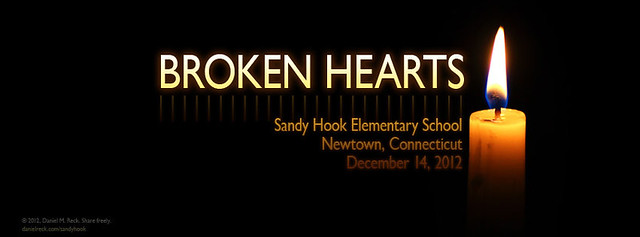
In December of 2012, the second deadliest act of school violence in America happened at Sandy Hook Elementary School in Newtown, Connecticut. Stories of fear, sadness, and of survival filled the news. Teachers everywhere cried for our fallen colleagues as stories of their heroism spread. Almost everyone in the field of education had to take pause to think, even if only for a brief second, "How would I react if that happened at my school?"
We don't want to think about it. We don't want to think that it could happen. We don't want to admit that it was real.
But regular incidents of school violence make it hard to avoid this thought--it could happen. It could happen anywhere.
Soon after the Sandy Hook shooting, my school announced an in-service on responding to school violence. Our large staff gathered in the cafeteria to listen to a local police officer talk about our current policy--one of locking down classrooms, locking down the building, and having the office be the main source of communication inside and outside of the building. The officer said that recent acts of shooting violence show that maybe the policy of locking down is not the best policy. Maybe teachers and school staff need to have more autonomy in crisis situations. He cited examples of teachers at Sandy Hook Elementary who reacted to the crisis in ways that saved lives--even though their actions may not have been sanctioned by the school crisis plan. New ideas about preparing for school violence indicate that teachers should be able to make decisions themselves--about whether to flee, find a good hiding spot for students, or stand their ground and fight. We watched the video below outlining the choices in a new kind of training--A.L.I.C.E. (Alert, Lockdown, Inform, Counter, Evacuate.)
After watching the video, we had time for Q&A, and then we broke into small discussion groups. We were given scenarios to talk about, asked to hypothetically apply A.L.I.C.E. protocols and take notes about what would need to happen in our school to make the new protocols possible. We sat around discussing what we would do if a student told us that she suspected one of her peers had a gun in his backpack. We talked about what would happen if there was an active shooter in the building who violently attacked the secretaries first, leaving our communications hub without any staff to let the rest of us know what was happening. Everything was very professional, very calm. We took notes about the fact that our school doesn't have the right kind of classroom door locks to lock out an intruder, that our intercom system is not very effective, and really thought about changes that need to happen to keep our school community safe.
And then we got out of in-service and I fell apart. We had spent 2 hours matter-of-factly talking about an active shooter in our building. Some teachers were envisioning throwing kids out the second story window to the courtyard below to keep them alive. We talked about running to nearby houses to escape being shot. I was thinking about the heroes of Sandy Hook and wondering if I would be able to give my life to save my students. Could I really, in an instant, put myself in harm's way to save the life of someone else's child....leaving my own children motherless?
When it comes down to it, I don't think any amount of training is going to answer those questions. Like so many things in life, you really don't know how you'll react until it's happening. But local police and our district administrators want us to keep thinking about how we'll react. They even want us to practice. They say, "We practice fire drills even though there are rarely school fires. We practice tornado drills even though there are rarely tornadoes that touch down on school buildings. We need to practice how to respond to an active shooting situation, even though the likelihood of that situation occurring is small."
So we had a second in-service. This time we met in the theater and the officer in charge of the training asked for volunteers. A group of ten colleagues sat on the stage as victims. They pretended to hide from an active shooter. An eleventh colleague got an orange rubber replica of a handgun, and entered from off-stage. He was instructed to find everyone and pretend to shoot them. Within a few seconds, everyone was dead. The officer then had the shooter go back offstage and told us that we'd just seen the result of a policy that says we must lockdown in a crisis situation. Things could be different if we used A.L.I.C.E. techniques. We could fight back. He handed out tennis balls to the staff that had previously just been hiding, and he asked the pretend-shooter to return. This time, when he entered he was bombarded with tennis balls. Those who were previously victims, now had the time to run, hide, or find something else to use in self-defense. The officer talked about items in our classrooms that can be turned into barricades or projectiles--things that could protect us. He gave tips on how to prevent the shooter from being able to use his gun--hang on to his arm using all of your weight, wrap yourself around his legs so he can't walk.
During this in-service, I found myself daydreaming. I kept trying to bring myself back, to pay attention to what was being said...but I couldn't. I kept shutting it out. I kept saying to myself, "I don't want to think about this. I don't want to think that this could happen. I don't want this to be real."
I don't know how I would react. All I know is that in my job, every day is different. I have spent 15 years working with kids who have significant behavioral and emotional challenges. I never know what kind of day it will be, what will happen. But so far I have survived. I can only hope that if some act of violence happened, I would survive. I don't know if I could rise to the level of heroism shown by Dawn Hochsprung, Victoria Soto and Mary Sherlach, who all lost their lives protecting kids at Sandy Hook Elementary. It is painfully hard to even think about. But it is reality. Teachers have to worry about Core Curriculum, integrating technology, closing the Achievement Gap, evaluations, assessments, diminishing budgets...and how to react to an active shooting event. Somehow, that last part isn't something I ever thought I'd had to prepare for when I decided to become a teacher.

