Showing posts with label at-risk youth. Show all posts

Nov 4, 2012

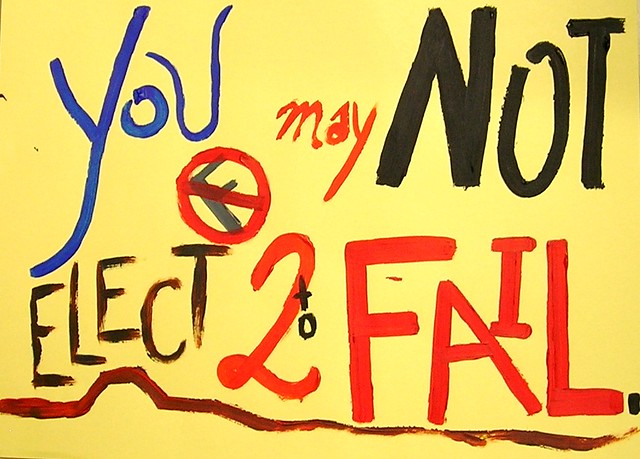
No Fail


"Y'all are askin' me to do too much! It's just too much fam, it's too much!" He sits next to me and is shutting down. His English assignment is basically untouched in front of him. A pen sits idly next to the blank page, waiting to prove its utilitarianism.

The end of the term is less than a week away, and at this moment he is failing English. One failed class means he is behind in credits. Will not graduate in May with his class. Probably won't return next year to be humiliated as a so-called "super senior." Thinks he'll just drop out.

It's a lot of stress and pressure for both him and for me, because his mom is sick and will be saddened if he can't make it; because my school is really pushing an agenda of "F reduction." We are told not to lower our standards, but to reduce the number of failing grades. That means a lot of work, for both him and for me. We sit at a small, round table. I am tired. He is tired. And he is frustrated by the amount of work that still needs to be done. "I ain't fittin' to do this much stuff! It just ain't worth it. I'm never gonna pass. I might as well just drop out."

"If you want to drop out, there's the door. You can go ahead and walk out. But while you're walking, I want you to think about the fact that I am still going to be sitting here. I am feeling your pressure and I know that we are almost out of time, but we can do this. I am going to help you. I want to help you pass this class and graduate on time. But if you're just going to sit here and complain, and fight with me, I'm not going to do it. In the time that you've been sitting here complaining, we could've had one assignment done already!"

Does that sound harsh? Sometimes it seems like a fine line between encouraging a student and challenging them to stop feeling sorry for themselves. Stop talking about how hard it is and just try...  But they've experienced such failure already...and received so little support...that sometimes it seems like they just need a  big nudge--like a mother bird nudging her fledglings out of the nest.


He didn't walk out the door. He didn't choose to drop out. He wrote a paragraph and got one step closer to passing  English. We made a plan: I will excuse him from all the classes he is passing so that he can sit with me and work on English every day until the end of the term. We didn't just shake on the deal--we hugged on it. For the next four days, I may have to be harsh again if he starts to doubt himself. But I can tell you this: no matter how much he doubts himself, I will continue to believe.


Oct 14, 2012

The Key


Working with kids who have behavior challenges is never, ever dull. So when I had a couple of quiet days in a row, I knew that there would soon be a volcanic eruption. That eruption came early in the week and lasted several days. What follows below is a true story from my classroom. I share it (and plan to share more each week) because I want you to know that there are many young people whom our society seems to fear, or whose behavior leads them to a place of punishment (sometimes directly to prison)...But those behaviors happen for a reason. It is my job--and the job of my colleagues--to figure out why.  So when you read these stories, don't just gasp (the way my husband does) at the shocking nature of the behavior. Don't just shake your head and mutter about "kids today" the way a lot of people do. Think about what a kid must be going through, or what might be happening in their minds, that led them to act a certain way. Really, when you figure out the puzzle of why a behavior is occurring it changes the way you see a person. Empathy is a very powerful thing.

True story:
This week a girl was in study hall and she was very disruptive. She has this enormous belly laugh that made me smile when I first heard it (hard not to laugh along!) But she can roll that laugh for a full hour, non-stop. Her friends seem to enjoy getting her going, making sure that her laugh is all anyone can hear anywhere! Forget studying, thinking, talking, anything! When that laugh is roaring, there is absolutely no way anyone can focus. So she was laughing in study hall and wouldn't move away from her friends. She wouldn't quiet down. She refused adamantly and was referred to the Intervention Center to calm down. When the escort came to get her, she refused to go. Eventually, all other students in study hall were asked to vacate so that staff could try to calm her without any peers goading her on. It was the last period of the day, and when she finally calmed down her mom was called, and she was escorted off school property for the rest of the day. She was told she'd need to spend a day in the Intervention Center to problem-solve and get ready to return to study hall again at some point.

The day after her study hall disruption, she was in my room. She sat quietly in a study carrel at first, completing work that she was missing from class. Another student sat next to her in a separate carrel. (He had been referred to my class the previous day and had vandalized a wall pretty severely. He was doing a great job of earning his way back to class by processing through the incident, and completing his schoolwork.) The girl had a house key on a lanyard. She twirled it the way a lifeguard twirls their whistle...round her finger and back again, round her finger and back again. Eventually that twirling got boring, so she started whipping it around the wall of her study carrel, listening to it thump on the other side. But there was that boy on the other side, so the key kept whizzing by him as it hit the wall next to him. After a couple of near misses to his body, he did what I would have done: when the key came whipping over to his side of the wall he snatched it. The key came off the lanyard and he tossed it toward me. Now, I am totally uncoordinated and clutzy. That key may have been aimed at me, but I didn't see it coming until it hit the floor at my feet.

The key sat there for a moment and the girl said to me, "You need to give that to me."

I said, "No, I don't."

Almost immediately, she got up out of her seat. She headed toward me, and I thought she was going to get the key. She looked up at me mid-step and said, "You need to know that I do fight boys. All the time." As quick as a flash she changed direction and was leaning into the study carrel of the boy who'd been sitting next to her. There she began punching him repeatedly. He sat there, still, as she pommeled him; and I tried to maneuver in between them. Since they were both in a very small, confined space, I couldn't work my way in there. I had to grab her from behind and pull, all the while hollering for an associate who works in the room next door. (My own associate was escorting another student who'd had an earlier crisis back to class.) Help came quickly and together we separated the girl from the boy. I called my administrator on a walkie talkie to ask her what should be done next.

The consequence was that we would call the girl's mom to let her know we were sending her home. Physical violence will not be tolerated at school. Her actions led to one of the very few out-of-school suspensions doled out in my building.  My associate escorted her off school property, and she was instructed to stay off the property for a total of three days. I tried calling her mom but got her voice mail. My administrator tried calling later and was able to get through. The girl's mom was very understanding and supportive, but also let my principal know that her family has come upon really hard times. They've lost their housing voucher and are being evicted from their home. They expect to be homeless by the end of the week. At this point, they don't know where they will live or how they will get by.

And so I think about it....how would I feel if I was a young teenager and knew that within days I'd be homeless? What if I'd finally found a way to laugh out loud and was told to be quiet? What if I felt so scared and frustrated about my life that I'd look for any way at all to let some of those feelings out--even going so far as punching someone?

For sure, the reason for the behavior does not excuse it. No matter what is going on in her life, it is not okay to punch someone who was just sitting next to her trying to avoid being hit by a key. There is no place for physical violence in my room, in our school, or in our community. 

But now I can see why it happened. Now I can begin to talk to her about less harmful ways of expressing her fear and frustration. I don't know if it will work, but I have to try--not only to help with her behavior, but to see if there is anything at all our school can do to help her family through this hard time. We start our problem-solving journey tomorrow. Keep us in your thoughts and send some positive energy to Iowa for us--especially to her. Her family needs all they can get.


Sep 16, 2012

The Angry Young Man


One particular student is on my mind this week. He is in the back of my brain, nagging and pulling--like a thread that needs to be unknotted. He is an enigma to me because I have not yet seen that kernel of goodness that I can always see in every single teenager I meet. I know it's in there, but I haven't dug deep enough to find it yet.

He is angry. Oh, so very, very angry. As I try to teach the parts of speech he mutters under his breath, "Where's the real teacher. You ain't no real teacher." He tells me I'm ugly. "Stop talkin' to me. I don't want you talkin' to me." It goes on and on, day in day out.

Sometimes, though, he answers a question in class. He names a character from the book we're reading. He participates briefly. It is those moments that keep me going. I know he is in there. Somewhere. Trying to get out. There is a young man who wants to learn, who wants to care and be cared about. I know it.

Then it goes back to the muttering under his breath. Anger personified. Verbally vomiting negativity like he's been infected by a viral hatred.

You may ask, "How do you put up with that? Why would you want to work somewhere where a teenaged boy insults you day in and day out?" Some days I wonder. But most days I know...

I do what I do because children don't have a choice about what family they are born into. Children don't have a choice about how their parents treat them. I know that this boy learned his foulness from a rotten apple that did not fall far from the tree on which it grew. I know that when a young man is so skilled at issuing verbal abuse at such a young age, it can only be because he learned it at a younger age from someone else.

Is it too late to change the tide? Is it too late to teach him to be more positive? I honestly don't know. But I do know that I couldn't live with myself if I didn't try.

Sep 2, 2012

Behavior Challenges

Flickr Image Credit: Psychology Pictures
The Theory:
Kids are exhibiting behaviors because they are trying to communicate something. They are most often trying to gain attention from peers or teacher; or trying to avoid/escape something that is unpleasant. If we can figure out what they are trying to communicate and teach them to communicate the need for it in a more appropriate way, the behaviors will decrease and eventually (hopefully) go away.

Example from the trenches:
One of my students is constantly on his phone during English class (I teach English one period of the day and spend the rest of my day offering behavioral interventions/learning supports.) When I speak to other teachers about him, they say they are seeing the same thing in their classes. It doesn't matter how many times you redirect him, ask him, tell him to put it away--he is always on that phone.

Finally, one teacher referred him to my room for a behavioral intervention when he refused to put his phone away. He was upset about being sent out of class, but eventually told me two things: first, kids today are addicted to their phones and adults just don't understand; second, he was kicked out of his house and has no place to stay the night. He is texting people to find a place to sleep.

There was no guesswork involved here--he effectively communicated his needs to me as soon as he was away from his peers and away from the teacher. I tried to let him know that when a teacher asks him to put his phone away and he doesn't, it is perceived as disrespectful. A better way to do things might be to ask permission to use his phone. He argued, "They ain't gonna let me just use my phone!" So I told him I would email his teachers, asking them to give him a one day pass to use his phone if he asked appropriately. (One day only, because I want small steps, and because I don't know the kid well enough to know if he is playing me. I don't want to give him a free pass to use his phone for Facebook in the hallway every day!)

I did email all of his teachers with a request. I let them know that I don't think we can break him of his constant need to use his phone. We need to start small. So for ONE DAY ONLY, if he asks to use it appropriately--please let him use it. He's having some difficulties at home and hopefully he can work through them appropriately.

The next day in my English class, he had his phone out again. He had not asked appropriately to use it. I reminded him, "Remember--today you can use your phone if you ask appropriately."

He said, "Can I please use my phone to text my mama?"

"Thank you for asking appropriately. You may use your phone to text your mama, then please put it back in your pocket." He sent one text message and then put his phone in his pocket for the rest of the period.

In that situation it worked. The theory meshed with practice. We are on "Day One" of a small plan to change a problem behavior. There will be ups and downs. He will relapse and get grumpy about teachers asking him to put his phone away. But we started down the path of appropriate communication.

Things the Behavioral Approach Doesn't Do:
My student communicated two things to me that day he was referred for an intervention, and one of them is--in my mind--more significant than his addiction to his phone. He doesn't have a place to sleep. There is nothing a behavior plan can do to solve that problem. That takes good, old-fashioned human interaction, a support system, and help from outside agencies. It takes a lot of good relationships to help with those problems: relationships with kids, parents, and service providers. Those relationships take time. And when a kid doesn't have a place to sleep, it's hard to figure out where to get help (especially when you're new to the job, like I am.)

Flickr Image Credit:Psychology Pictures
So here is my dilemma: 
The theory makes everything so cut and dried. Behaviors occur to communicate a message. Decipher that message, change how the kid delivers it, end of problem behavior. But what if the message the kid is inappropriately delivering is one of human suffering? In my first weeks on the job, I have received some messages loud and clear, "I am depressed." "I have no place to live." "We can't pay our bills and the lights have been turned off." Somehow, just teaching them more appropriate ways to say those things is not enough.

Behavioral consultants visit our school and tell us how things should be done. Their suggestions are to follow protocols and read from scripts. Everything is de-personalized and sanitary; there is no human element. It is all Pavlov's dogs and Skinner's rats. But how do you tell a kid to express their concerns about life more appropriately without helping to alleviate those concerns? I am learning that this is the true challenge of my new job: a balancing act. Alleviate those who want me to only use a behavioral approach by doing as much of that as I can; but also alleviate the kids' struggles and my own sense of right/wrong by using a humanistic approach--caring and problem-solving--whenever I can.

I pray that the behavioral approach and the humanistic approach are not mutually exclusive. Because there is no doubt in my mind that to be even slightly successful with these kids--I will need both.


Jul 22, 2012

Bad Kids


I heard another story about that kid last week. All school year he's been nothing but trouble. He was caught red-handed in the pantry, breaking into cabinets filled with supplies for the after school program. Soon after, he was caught with fifty dollars that he'd stolen from a teacher's desk. 

Last winter I watched him play basketball, calling the boys on the opponent's team, "bitch" (and that is the least foul of his words.) I've seen him get angry and throw things: his desk, a chair, wild punches,  tantrums. He is nothing but trouble. The families in our neighborhood have tried to welcome him into our homes to help him, but we've all been burned too many times. He's stolen multiple video games and gaming systems from us, been rude, eaten our food, never given thanks. He curses and cusses in front of the really little kids. He is just bad news. 

Kids like him are in our neighborhoods and classrooms across the country. They sit with our kids and expose them to all kinds of filth and foulness. They should just get kicked out of school. Suspended. Expelled. They need to be kept away from our kids. Our kids need to be protected. They don't need to be exposed to such anger and violence. Those kids are headed straight for prison, anyway. There's nothing we can do. They're just bad kids. 

When you see him, you can just tell. He's angry. He doesn't have a future because he can't control that anger. He doesn't know the difference between right and wrong. In a lot of ways, that kid is scary. Such anger is hard to control. A loose cannon. You never know what he's going to do and that unpredictability is frightening. He could be a psycho gang-banging drug-dealing killer some day. What a bad kid.

Except...all of that is what we see on the outside.  All of that is the external circumstantial evidence. What's going on in there? Really? Who is that kid?

When you talk to him, if you are patient, and you try to crack through the hard shell to get to the soft innards, then you find out that he is hungry. Dad left. Mom doesn't have a job. He's hungry. His only meal is the free lunch offered at school every day and since he is a growing boy of 11 years, it is just not enough. The pantry he got caught breaking into is filled to the brim with food for breakfast and snack at the after school program. He just wants to eat.

The $50 he took from the teacher's desk? He was caught with it at the grocery store, trying to buy food for his little sister. She is home all day without food, too young to go to school and get the free lunch.

The video games and gaming systems he took--he's not playing with them. His one-bedroom apartment doesn't even have a TV. He's been taking them to the gaming store in the strip mall by the grocery store. He sells them there and takes the cash next door to buy food.

He is 11 years old and he is too young to get a job, but he is the sole provider of sustenance for his family. He walks around the neighborhood and sees his classmates riding their bikes, playing in their yards, hanging out and playing football. They don't have to worry about eating. They don't have a daddy who left them. They don't have a mom who is so depressed about losing her job and her husband that she can't get up off the floor of their apartment. They don't have to worry about the eviction notice that just got stuck to their front door. They don't have to worry... and it makes him angry. He is so angry he can feel the rage just rising up from his toes...to his fists...to his head. Just one person says something wrong and he will show them how it feels to hurt like he hurts. Just one thing. Go ahead, say it you mofo. Say it. 

Sometimes they say it at school. Sometimes in the middle of a football game on the corner. Sometimes they don't even say anything anyone could really consider an insult, when it comes right down to it. They just say something that reminds him about what they have that he does not. They remind him that he has to find something, some way to feed his little sister again tomorrow. They remind him that he likes his teacher and he wishes he could learn, but eating is more important right now. They remind him that if he steals at school again he might get sent away to some place for bad kids where you get to spend the night. In a way, it might be okay--probably more food than at home, and no eviction notice on the door. But who will feed his sister then?

Angry. So angry. No eleven year old should have to live like that. I'd be angry too.

There really is a kid like that in my neighborhood. Kids just like him really have been in my classroom. Parents of other kids really have said, "he needs to be kicked out," sent away, banished--to protect our kids. Somehow, though, I wish they could see the big picture, the whole picture...who that kid is both inside and out. Because when you really know him, it's hard to believe that anyone can say he's a bad kid. He's in a bad situation and making some bad choices...but he is not a bad kid. He's doing what he can to survive.

And if he's not bad, then you have to wonder about every single human being who does something bad. Are they really a bad person? or are they in bad situations making bad choices, stemming from a life filled with pain and hurt and anger? Are there any bad kids, really?

In the wake of the Aurora, Colorado shootings...this is something I have really been thinking about a lot lately. 

Is anyone really, truly bad? 

May 27, 2012

Graduation and Ball Games


Image via Flickr/paul.hadsall

Two of my kids are playing ball right now, so I have softball and baseball on my mind (3-4 games/week plus practices makes it hard to think about anything else, honestly!) I've also attended a few graduations besides my own, been to some graduation parties, and been reading about graduations in the paper. Put the two together--ball games and graduations--and here's what I've been thinking about. 

For some kids, playing ball seems to come naturally. They are born with a talent for the game and can connect with the ball just about every time they are at bat. It almost seems like they have an advantage! They know how to play the game, and know how to turn a single into a double, or a double into a triple by being fast and paying attention to the game. For those kids, it almost seems like they're starting out on third base! It's fun to watch their natural talent blossom. They represent the innate beauty of pure athleticism. But there are other kids who start swinging and missing from home plate. They have to use every ounce of strength to hit the ball far enough to make it safely to first base. They have to pay extra close attention to the game so that maybe they can steal second. Then they get stranded at second, and have to wait for the next inning so they can begin the process all over again. 

Imagine a game like this: the struggling kid finally gets on second base after two innings of trying. The runner ahead of them on third could potentially score the game winning run. A ball is hit along the third base line. The third base runner heads home and scores the final, winning run of the game. We celebrate that game winning run with fervor and excitement! The team rallies around the winning runner, the crowd hoots and claps and cheers. Meanwhile, the kid who has fought so hard to make a hit and get on base is left alone. Silently running the bases. Touching home just to say that they made it. In the stands, we often don't pay attention to those kids. They don't get our hoots and cheers and high fives, even though their arrival at home plate took much more effort, more work, and more struggle than the home run of the natural athlete. Their run was scored after the game's official ending, so it really doesn't count.


Image via Flickr /MomMaven
Seven of my own students walked across the stage to receive their diplomas last weekend (another one from a different high school walks today.) Those seven students were from a rural Iowa high school that had a graduating class of 60 students. Seven out of 60 were at risk of dropping out, but they made it! For several of them it was a huge accomplishment, a graduation that occurred against all odds! Some kids have overcome poverty, survived the death of a parent, divorce, health problems, and/or other seemingly insurmountable issues---but they made it! Seven out of 60 means that those alternative school graduates made up just over 11% of the senior class. During typical commencement ceremonies, only the top 10% (or less) is recognized.

On Friday, my wonderful former student-turned-current-co-worker held a surprise going away party for me.  I was shocked to look around the room and find out how many of the attendees were kids who didn't earn a diploma when they were working with me. They left my program at age 17 or 18, and went on to either get an adult high school diploma, a GED, or to pursue a job. In the statistics I put together for the state at the end of each year, they are dropouts ("failures") and not recognized in any positive way for their accomplishments--even though they had to persevere and show more stamina than many of their peers to get where they are now.

Yesterday I was reading a newspaper story about the ceremony held Friday night for the students graduating from the school I will be teaching at next year. There is a long list of Valedictorians, Salutatorians, and all of their academic achievements. So many kids earned scholarships and are going on to do impressive things at colleges and universities all over the world. 320 graduates, the highest average ACT score in school history, and many other achievements and honors were bestowed upon the class of 2012 at my future place of employment.

But here's the thing...while there are a few stories of Valedictorians and Salutatorians rising up after difficult childhoods, most successful kids started their k-12 educations with:

  • At least one parent who graduated from high school and attended some college
  • A mom who at least knew about the benefits of breast feeding and didn't feel pressure from social service agencies to sign up for free formula
  • A roof over their heads--and most likely the same roof for a good portion of their childhood (in other words, low mobility and lots of routine)
  • At least one parent who read to them every day as a toddler
  • Access to quality preschool
  • At least one parent who could help with homework after school
  • Access to quality after-school programming
  • Transportation to and from programming after school
  • Regular meals, every day, every month, every year
  • Clothing that not only fit well, but allowed them to fit in well
The most successful kids have all of that, and more, as they grow up. They are set up for success, and the only thing that limits them is their own free will, their own desire to succeed, their own passion for learning. The top 10% of each graduating class sets itself apart because they are driven! They make a commitment to go above and beyond what most of their classmates do, and I agree that they should be recognized for their accomplishments! But I also wish we could recognize the amazing achievements of some students who didn't start out with all that, and still somehow still make it to graduation.

In the game of life, some kids start out on third base and don't even know it. Others struggle to make it on base, work hard to advance, but sometimes don't make it to home plate until after the game is officially over. I am glad that we celebrate the game winning runs! But shouldn't we also celebrate the kid who keeps coming back, inning after inning, trying their best to make it home--even if their feet don't get to home plate until after the game is over?

There are kids who overcome obstacles like parents who are addicted, homelessness, abuse, the death of a parent, poverty and hunger. They try so hard. They overcome so much. For me, those kids accomplish something that is every bit as amazing as what the top 10% of the class does. I wish there was some way to recognize them, too. I wish commencement ceremonies could honor both the top ten percent, and a few of the kids who kept trying, no matter what life put in their way, and finally made it. 

The 11% who worked with me in the alternative program accomplished so much. And I'm sure that among the 320 who graduated from my future school, there are some stories of accomplishment just as great. 

Woo hoo! Congratulations! High Five! Even though you didn't make it to home plate in the usual way, or maybe even during the regular game, I applaud all of you graduates out there who finally did it! 

WAY TO GO!


Jan 1, 2012

Boost Nation: Send a Message to Struggling Teens

Probably more than ever before, high school students need extra help to graduate from high school. So many teens have extra responsibilities: caring for younger siblings, working jobs to help support their families, or caring for their own children. The dropout rate is really high in every state across the nation. (You can see how high it is in your state by visiting this site.) Even though the dropout rate is high, YOU can make a difference in a kids life by visiting BoostUp.org

What I love about this site is that you can TAKE ACTION! Leave a tweet-sized message for a teen who is at risk of dropping out. Make a video for kids in your state, encouraging them to finish high school. Find a local mentoring organization and donate your time. Make a difference with Boost Nation. Here is a sample video from their site:


Boost Nation | Encouraging our nation's students: Every 26 seconds, of every school day, a student drops out. Boost Nation, a project of BoostUp.org, lets you share your own message with students, helping keep them on track to graduation.


Oct 30, 2011

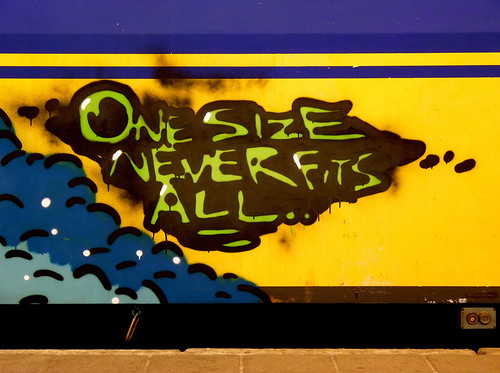
One Size Never Fits All

Image Credit: Flickr/Akbar Sim (voorheen Meneer de Braker)

This week a struggling high school student visited my alternative program asking about how to enroll himself. In a nutshell, here is what he said:
  • I am a senior and I really want to graduate this year.
  • I struggle with reading and writing, but when I ask for additional help from my English teacher she tells me that she's already explained things to the whole class and she doesn't have time to explain it to me again.
  • I am really, really good at math. My teachers just need to show me how to do a problem once and then I can do it in my head. But I've flunked almost all of my math classes because I don't show my work; or when I do, I don't do the problems the same way as the teacher wants them.
  • My school seems to think that one size fits all when it comes to learning...but their ways of teaching don't fit me! I wish I could go somewhere where I could test out of math classes and get extra help in English. I wish I could go somewhere that offered more hands-on learning because I learn better when things are hands-on.
I was so impressed with this student's self-awareness and motivation! He wants to graduate, he knows his academic areas of weakness and his academic strengths, and he knows how he learns best. These are all qualities that will benefit him greatly in the world of work. But in a traditional school setting, those same qualities are forcing him to consider dropping out or getting a GED. There is something very wrong with this picture!

This student is exactly the kind of student I recommend for enrollment in my alternative program---but due to constraints of the educational system, he cannot enroll.  Why? 

The student who visited me does not attend one of our partnering schools.  We are an alternative program not an alternative high school. This means that we do not offer our own high school diploma; instead, we partner with traditional high schools in our area. They dictate the graduation requirements for their students and provide funding to support our offsite program. When students have met all graduation requirements, they receive a traditional high school diploma from their home school.  If this student attended our program, any work completed in our program would be worthless because it would not count toward a high school diploma from a partnering school. 

Why doesn't the school just partner with our alternative program so that this student can earn a diploma? In this case there is one main reason: the school the student is enrolled in has its own alternative program. They don't want to send someone to another district when they have their own alternative classroom. The problem is that their alternative program only offers computer-based instruction for at-risk students. Their alternative program adopts a "one size fits all strategy" that is different from the traditional school's strategy, but still only offers one style of learning for all of the kids enrolled.

It is frustrating for this student to know that there is a program like mine that would offer him choices when it comes to learning, that would offer him more one-on-one assistance if he needs it, and that would allow him to graduate on time with his class--but he can't enroll because he doesn't live in the right district. It is frustrating for me to see a kid who so clearly exhibits qualities that will make him a successful adult, who is motivated to do what it takes, but might not graduate because of school finance and residency issues.

A lot of people talk about school reform. A lot of people talk about issues relating to teachers and how they are paid, about standardized testing and failing schools. But what about the kids? Where is the ed reform plan that focuses on the kids? The student who visited me is one of many, many kids who want to learn, but feel lost in the system. No amount of standardized testing or teacher salary-adjustments will help him be successful in our current educational system. At what point do we stop trying to fix the small stuff and realize that it's time for a system-wide change? 

In my dream world, that student would walk into our school building and be welcomed with open arms. Home address and financial partnerships between districts wouldn't matter. A kid wants to learn and a school wants to help him--that's all that should matter. How can we make that dream come true?


Akbar Sim (voorheen Meneer de Braker)Akbar Sim (voorheen Meneer de Braker

Sep 18, 2011

What if? Thoughts on Ron Clark Academy, Parents and Teachers

In 2009, I attended  the Risky Business Conference for educators who work with at-risk youth. Mr. Ron Clark was the keynoter. I don't think there was a single person in the audience who wasn't captivated by his presentation. He is an entertainer, and both his classroom and his school (Ron Clark Academy) are lively places. Watch this video to see what I mean.


Ron Clark is very innovative. He has a unique style of teaching, leading, and talking about education. The overwhelming quality I sensed in his presentation at Risky Business is passion. He loves what he does and he loves his students.

Looks great, right? Here's some background on the Ron Clark Academy (from the RCA student FAQ page):
  • Potential students must apply while in 4th grade.
  • Approximately thirty 5th graders are admitted each year. Students in grades 6-8 are not admitted.
  • 5th graders are expected to remain in the program for 4 years in order to achieve the greatest success from the Academy's program of study.
  • Average class size is 30 students (these are not all gifted students; a majority have learning or behavioral issues.)
  • It costs money to attend RCA. There is a sliding scale for tuition and many fees are offset by scholarships, but admission may be limited if there are not enough corporate donations or sponsors.
There are many teachers across the country who have a lot of passion. But their passion is sometimes limited by barriers that the Ron Clark Academy has worked hard to break down. Due to corporate donations and sponsorship, RCA has a beautiful building with up-to-date technology. Class size is limited--the school only has about 120 students, on average 30 kids per grade. Those kids stay together for four years, which means they really build a strong sense of community. They have relationships with each other and with their teachers. And I guarantee you, that RCA parents and teachers also get to know each other pretty well. How could they not when they are together for 4 years in such a small school?

Many things strike me about the Ron Clark Academy. First and foremost is that I think the vast majority of teachers and students would thrive in an environment like the one at RCA. With proper resources, a nurturing environment, and lots of stability, amazing things can happen. Throw in high-interest curriculum that engages students' bodies and minds...how can it fail?  

The reality is that most communities and school districts can't break down those same barriers without strong intervention from our government. It would take a great deal of change to make your average public school look anything like the RCA (not to mention a great deal of money.) What can change? On a small in-your-classroom level, teachers/parents/students can work on building better relationships. Education needs to be personal. It needs to be individual. We need to look at each kid for who they are and what they can do and tailor our instruction to meet their needs.

___________________________________________________________
On September 6, 2011 CNN ran a piece by Ron Clark, titled "What teachers really want to tell parents." It caused quite a stir in the Twitter-verse, with both parents and educators taking issue with many of his points. Lots of people have written responses. CNN ran a piece based on comments to Clark's post. Doug Goldberg of Special Education Advisor wrote a piece expressing his frustration with Clark's seemingly antagonistic view of parental involvement that you can read here. In another post about the controversy, 6th grade teacher, Josh Stumpenhorst, reminds us that while there most definitely are some bad parents and some bad teachers, we cannot make assumptions about all parents or teachers. Each individual must be approached as an individual. 

I agree with Josh on that notion of individualizing each educational situation.  That said, I kind of wish Ron Clark had simply sent his letter out to the parents in his Academy. They have a history together, a relationship where such commentary could be like extended family talking after Thanksgiving dinner--sometimes you don't all agree, but in the end you're still family. The rest of us are not a part of that dynamic, not involved in that relationship. I don't know of any other school quite like the Ron Clark Academy. Issues there are not the same as issues in other schools. Most schools don't have the same physical environment (does your school have a slide from the second story to the first?) Few schools have such up-to-date  technology (digital keyboard accompaniment to math songs! and SmartBoards in every classroom!) Most schools don't have such limited class size, and are unable to keep the same small group of kids together for four years. Most schools don't have such a small student:staff ratio (this photo shows 20 staff for about 120 students. Also, note how many teachers of color there are! The staff actually reflects student demographics!) Maybe if we all started out with the same corporate-sponsored structure in place we would have a better chance at creating close enough relationships with parents to say the things the Ron Clark said in his piece. 

Currently in education, we are suffering from a climate of blame. Many teachers blame parents, and many parents blame teachers. One thing many have discovered as a result of the recent Ron Clark controversy is the fact that both groups need to communicate with each other better. There is a common goal here: educating our kids.  The focus should be on how to work together to eliminate barriers to learning; how to turn our schools into strong communities where students, teachers and parents have effective relationships, and are united by a common goal: success for our students. I encourage teachers and parents to reach out to each other--to really listen to each other. Don't blame, and don't assume that what works in one educational situation will work in all situations. Treat each other as individuals. I think that if we all do that, we can start to build relationships, to work together, and to eliminate barriers to learning. What if we all learned to treat each other individually? What if we could stop making assumptions about parents, teachers, students, schools? What if we could truly individualize education? 

Sep 4, 2011

Accentuating the Positve

The first weeks of school are hard. My students test my limits over and over again. I dish out consequences repeatedly. I can't let up even once in these first weeks, or they will not learn these valuable lessons:
  • Our classroom is predictable (unlike many of their lives outside of school) 
  • Everyone is the same, but everyone is different. I will do my best to be fair--which means that a student with a disability may have different tools for completing their schoolwork than a student without disabilities. However, the consequences for not completing work will be the same for everyone.
  • Some behaviors are acceptable and some are unacceptable---whether in our classroom, on the job, and in society. Acceptable behavior is rewarded. Unacceptable behavior will have negative consequences. 

Todd's book
This past week I found myself falling into a pattern of negativity: "You can't swear in public like that. It gives people a really bad impression of our school." "Don't talk right now. You're disrupting those who are trying to get work done." Every day I found a way to say what my students were doing wrong. I forgot to tell them what they were doing right.

Several years ago I had the pleasure of attending a presentation given by Todd Whitaker.  Todd is an educator and speaker who is spreading the word about what good teachers do. His tips are often simple and seem like common sense; however they are not commonly practiced. During the presentation I saw, Todd talked about this common scenario outlining the way teachers handle disciplinary issues in their classrooms: 

One or two kids act up. The teacher yells at the whole class. Everyone feels badly--even the majority of the class, who didn't act up at all.

He suggested that we change that paradigm in this simple way: One or two kids act up. The teacher praises and rewards the kids who did not act up. Those who made positive behavioral choices feel good. Those who did not are left out.


That simple premise is the foundation for a research-based practice called Positive Behavior Interventions and Support or PBIS. Many elementary schools are trying to stop punishing all students for the behaviors of a few, and are instead setting clear expectations, modeling positive behaviors, and rewarding those who meet behavioral expectations. It is a proven program that literally changes the climate of many schools. But all of the guidelines I've seen are for younger kids. I often wonder: How can PBIS be adapted for high schoolers?

Being negative and only focusing on what kids are doing wrong is a tiring business. They get frustrated. I get frustrated. Everyone feels grumpy all the time. Mid-way through the second week of school this year I was so tired that I knew something had to change. I remembered Todd Whitaker's presentation, and I remembered a lesson from a powerful curriculum called Reconnecting Youth (a research-based curriculum designed to help at-risk students attend school more regularly, improve their grades, reduce drug use, and decrease suicide-risk behaviors.) The lesson involves finding something positive about each individual in class and pointing it out publicly. It's been a while since I've used the RY curriculum with my students, but last week I decided it was time to accentuate the positive. 

I got a bag of plastic silver and gold tokens. I printed out a sheet of memo pages with the heading:

A Token of my Appreciation…
Flickr image credit: WayTru 
Then I hand wrote a note to each of my students about something I appreciate about them. I wrote their name, a note of thanks, and signed my first name. When school started, I handed each student their note and a plastic token, saying "This is a token of my appreciation. Thank you ____ ." 

I'm not going to lie. For some kids it was a stretch to think of what I was thankful about. But those kids are the ones who most need to know that I see them, and that I want them to succeed. Their messages included statements like this: "Thank you for coming to school twice this week and trying your best. I know that if you keep coming you will graduate. I believe in you."

Will it make a difference? I don't know. I can only guess that Todd Whitaker, the developers of RY, and PBIS are really on to something with their idea of modeling/rewarding positive behaviors. So I am going to try to think of other tokens, treats or positive rewards to give to my students in the coming weeks. I don't know whether or not it will make a difference to them, but I know for a fact that it feels better to me. New goal: accentuate the positive.

If you have ideas about another token, treat or reward I can give to my students please share. I'd love to hand out one a week. I'll keep you posted on how it goes.


Aug 21, 2011

The Power of a Symbol

Several years ago I had a group of students who thought it was "cool" to draw swastikas everywhere. They drew swastikas on their schoolwork, on their clothing, and on their skin. I was horrified. When I asked them to stop, they questioned my motives. "We don't have any Jewish kids here. It's not offending anyone!" I told them it was offending me, and I wanted them to stop.

They did not stop, however. Swastikas continued to appear on their schoolwork and on their skin. One boy used a permanent marker to draw a swastika in the middle of his forehead.  He wore it with pride. He made sure to take off his hat when facing me so that I could see his open defiance of my request. When I looked at him questioningly, asking, "Why did you do that? I asked you to stop." He recited to me the thousands year-old history of the swastika, and assured me (with his blonde hair and blue eyes) that he did not intend for anyone to take it in an Aryan way. He was not a racist or a Nazi, he said.

 
Flickr Image Credit:Wm Jas 
I was deeply disturbed by his insistence that wearing a swastika on his forehead is something to be proud of. The previous year, a different group of students had gone with me to the local nursing home to interview residents about their experiences in WWII.  Their pain was palpable. To have this young man not show any regard for the memory of that pain bothered me immensely. I could only conclude that my student did not know the more recent history of that symbol well enough. As his teacher, it was my job to teach him. I could look at him and say, "YOU are a racist," which would cause him to become more defiant and angry. Or I could try to get him to see things from another perspective.

While thinking about how to approach the subject, I realized that the biggest challenge would be getting these rural, poor, white kids to put themselves in someone else's shoes. I thought about just showing them a movie like Schindler's List.  But that is just a movie. It is so easy to dissociate one's self from a movie; that's not real--it's Hollywood. Instead of a movie, I got the documentary World War II -- The Lost Color Archives. Even with its gut-wrenching scenes from the concentration camps, I didn't think that my students would find much reason to relate to the footage on a personal level.  I struggled to think of a way to make them aware of what the swastika symbolizes to so many people.

My students have all experienced pain. Some of them have experienced so much pain that I am amazed by their ability to survive. The boy with the swastika on his forehead was one such person. His history involves both physical and sexual violence, both of which deeply affected him. Many of my other students had similar backgrounds.

Two days after discovering the swastika-on-the-forehead , I told my students that we were not going to complete any of our regular schoolwork. "We are going to have a discussion. It will be a really serious discussion and I will be sharing some very personal information with you. It is my hope that you will feel comfortable enough to share some things about yourself, too. Because it is so scary to share such personal stories, I need you all to agree to treat each other with respect. If you cannot handle that, you may leave right now. You will not be penalized for leaving. But you will be penalized if you are disrespectful to anyone sharing their personal stories." No one left.

After sharing the story of one of my darkest memories, I asked my students if they had any similar memories. I was shocked by the number of kids who had been living with immeasurable pain. Rape, physical abuse and mental abuse are far more common than I'd ever thought they were. After an intense period of sharing and tears, I asked those who had been brave enough to share, "Are there things that you see, hear, or smell that seem to send you back in time? Do you have flashbacks?" Each one of those kids could name a scent, an object, a song that froze them in fear, making them return in their minds to the time and place they were hurt so profoundly.  I asked a girl who admitted to flashbacks  how she would feel if I played the song that triggered her flashbacks each day as she entered our classroom. I asked the boy with the swastikas how he would feel if I presented him with the trigger to his pain each day. I told them that while the swastika does have an ancient history as a symbol of peace, there are people alive today who will not see it as such. For those people, wearing a swastika is like forcing them back in time to their moment of pain. Then we watched the documentary together.

We wept together. All of us.

At the conclusion of the film I asked them if they now understood why I was so upset by their casual display of swastikas. With red eyes, they all nodded. The boy with the swastika on his head got up to scrub his face in the bathroom. When he returned to the classroom he said, "This was an intense day. Can we have a group hug?" We all stood at the front of our classroom hugging each other for a long time.

That was the single most powerful day of teaching/learning that I've ever experienced in my career.

_____________
For the past week, two things have been on my mind: the movie The Help, and the start of the new school year. The story I just told brings together my thoughts on both subjects.

On The Help:There has been much controversy over both the movie and the book.  I didn't quite understand the controversy until I read this post by Ann Freeman (via Nordette Adams.) I am left wondering: if I read the book, if I see the movie: will I be wearing a proverbial swastika on my head? Am I perpetuating the pain of the past?

On the start of the school year: There is more talk now than ever before about teacher accountability for the learning students do in our classrooms. I just wrote about my most powerful teaching moment--one that deeply affected both me and my students. Yet none of what was taught or learned that day is considered of value in our current educational system. There is no bubble test to measure a student's growth in her/his ability to feel empathy. How do we balance this need for accountability with the need to ensure that kids learn more than just reading and math? For it is my opinion that they also need to learn more about what it means to be human.

Aug 14, 2011

I Choose


Flickr Image Credit: Scintt
Since 1996 I have been teaching in alternative high school settings. Next week I will begin my 14th year in the same classroom, working with a group of kids who are deemed "at-risk" of dropping out. Even after all these years, I still get nervous and excited about the first day of school...but not for the reasons that many people think I do.

It's taken years for me to get used to the reactions I get from people after I tell them what I do for a living. Jaws drop, eyes get big, and shock registers. Some bless my heart and nominate me for sainthood. Others ask very direct questions, like: "Don't you fear for your life?" Here is what I tell them: I am not a saint. I try my best to help kids graduate and I care about them; but I am no miracle worker. They earn their diplomas through their own hard work. My job is to believe in them and to remind them that they are extremely capable of being successful. I do not fear for my life. My students are just kids. Many of them have suffered greatly due to a variety of life situations, and that suffering often creates a tough exterior, a hard shell of protection from hurt. But underneath that shell, they are all soft-hearted kids. They are the ones who should be seen as miracle workers! Many of them are survivors, who somehow manage to not only overcome the obstacles they've faced in their young lives, but also to thrive.

Flickr Image Credit:TimsStrategy 
I recently read this post at De Su Mama, written by a fellow Multicultural Familia contributor. Vanessa blogged about her career in social services working with "at-risk youth," and it really struck a chord with me because I work with the same kinds of kids. She wrote about the way some kids are faced with seemingly insurmountable obstacles (abuse, violence, addiction, etc.) but are able to overcome those struggles and do amazing things.  She beautifully discusses that quality, as well as how to instill it in our own children--the quality of resiliency. Vanessa's post was linked to another that discussed resiliency in greater detail, naming five characteristics that help develop a child's resilience. One of those characteristics really stuck out for me because it is one I find myself focusing on both with my students and with my own children: Internal Locus of Control.


I have three children between the ages of 7-11. Here's a common scenario in my house: a loud crash, a burst of tears, footsteps pounding up the stairs, a shrieking cry, "MOOOMMMMMMY!!!! A just pushed B and now she's crying!" I separate the brawlers and try to figure out what happened by asking questions. Almost every answer to my questions includes these words: "Yeah, but..." My kids see a chain of cause and effect that always leads to the notion that someone else is to blame for their actions.  "Yeah but if she hadn't grabbed the toy out of my hand, I wouldn't have hit her!" That is an example of external locus of control--it's not my fault I hit her...it's hers!

Similar things happen in my classroom. My new students often come on the first day of school with huge burdens weighing them down--a history of pain, suffering, and failure. (No one comes to my alternative program because they have a history of success in a traditional high school setting--they are all there for a second chance.) Almost all of them start out by saying some variation of, "I can't": I can't do math because I failed it; I can't come to school every day because I have to help raise my younger siblings; I can't graduate because no one else in my family has ever done it.

They have some heart-rending stories about why they can't do things...but rarely do they see anything in their lives as the result of their own choices. They do not have that internal locus of control. "My mom says I have to;" "My friends will give me a hard time;""Yeah, but..." Rarely do they feel they have the power to make their own choices.

I get nervous on the first day of school because I worry about how effective I will be at helping students  students learn this powerful lesson: YOU HAVE A CHOICE. I worry about how many will choose to take responsibility for themselves and how many will blame me, their parents, or others for the things that happen in their lives. I wonder how many will end up strong enough to deal with both the positive and negative consequences of their own choices. (And I worry about how many negative consequences I will have to mete out before the choices-lead-to-consequences lesson is learned.) I get excited on the first day of school because when kids learn that they have the power to choose success, it is an amazing thing to watch! Some of my students start out as young, immature kids; but they leave as responsible young adults whom I admire greatly. I often start out the year feeling like a parent/disciplinarian and end it feeling like I have a new group of close friends. It is extremely exciting to watch kids transform!


To spur on this transformation, on the first day of school I like to let my students know: "You have a clean slate here. Starting today, it doesn't matter what classes you failed or how much trouble you've been in. Maybe you've suffered through a lot of pain because of what other people have done to you. Maybe you don't think you have what it takes to graduate. Well, starting today, you have a choice. You can keep worrying about your past, or you can start planning your future. You can let other people hold you back, or you can choose to break free. It doesn't matter to me who your parents are, why you are here, or what you've done in the past. Right now you are here, and if you choose to try to graduate I am going to help you in any way I can. You can do it if you make the choice to do so." Sometimes I play them this song by India Arie, "I Choose." It is a powerful message about everyone's internal locus of control. A reminder that I have the power to CHOOSE to be the best that I can be...

Resilience, the power of choice, and internal locus of control: that's what's on my lesson plan schedule for the school year. Let's hope they are lessons well-taught and well-learned...

May 30, 2011

Thoughts On Memorial Day

This Memorial Day I have a lot on my mind. At our end-of-year picnic, a parent told me that her son--my former student and the husband of one of my most recent graduates--was almost killed in action. Richard is in the National Guard, currently serving in Afghanistan. A flash bomb exploded close to him and he was lucky to survive. I hugged Linda, his mother, after she told me the news. The whole time I held her I was thinking of how I would feel if I had come so close to losing my own son.

I spend this Memorial Day thankful that I am not mourning the death of a young man who used to be my student.

I spend this Memorial Day worrying about him and about his friend, Brandon, another former student who is serving in Afghanistan.
All Rights Reserved, 2011 Bobby Duncan
I also spend this Memorial Day reflecting on other students who have all, thankfully, served in the Middle East and returned home safely-- in body, at least. They are, however, not the same in their minds or spirits. Their souls are forever changed by war. Because of them, and because of my two grandfathers who fought in WWII, I know that it is not just a physical sacrifice that our soldiers make; it is a spiritual sacrifice as well. Soldiers returning from war are not the same people they were before. Knowing this, I have always had a hard time supporting the recruiting efforts of our local military offices. They seem to target my students--those at-risk of dropping out, those who don't fit into a traditional system, those who suffer from poverty.

I just read an article by the Reverend Romal J. Tune posted here on the Huffington Post and it got me thinking about my own internal conflict regarding military recruiting practices. If you have a moment to read it, I think it is worth your while.

Just like every situation in life, each individual must decide what is best for themselves and then make their choices accordingly. As a teacher, I may not like worrying about my students who join the military (and I worry so much!) But for so many kids, joining the military is the only way for them to travel the world, learn new skills, and further their education. It is not my job to limit the available information about their options; it is my job to help them look at all of the available choices. It is my job to help them learn to make decisions for themselves about what is best for them. Once they make their decisions, it is my job to support them and assist them...and to hug their moms while we wait for them to come home.

May 26, 2011

Redemption, Part 2

In my last post I shared some amazing stories of kids who saved themselves from dropping out of high school. As a teacher, those stories are the ones that keep me going year after year. They inspire to keep getting up and going to work in the morning. But to be honest, they don't stick with me as long as the other stories--the stories of the kids who did not make it to graduation. Those stories haunt me, sometimes, and it is hard to let them go. I relive moments where I could've, should've done something to make a difference. I worry that I am no longer an effective teacher and start combing the ads to look for another job. I worry.

In the past few weeks I have been contacted by a few of the kids who didn't make it. These kids have been doing the same "could've should've" dance that I do when I think about them. 

A girl I'll call "M," who dropped out of school several years ago, messaged me on Facebook.  She's ready to finish school but doesn't know how to go about it. She asked how to go about finally getting her diploma.

A young man who has struggled with alcoholism since the age of 14, dropped out of our alternative program at 17. He will receive his diploma from an adult high school completion program this week at the age of 20.  

And perhaps the most impressive story of all:

 Some rights reserved by RambergMediaImages

The mother of a sophomore student who dropped out earlier this year visited this week. She said, "I realized that I can't get him to graduate if I never did it myself." She enrolled in the adult high school completion program and is proving to her son that it is possible for the people in their family to succeed.


Talk about redemption! It is never too late to strive for success. 

May 22, 2011

Redemption, Part 1

flickr photo by 1 
AttributionNo Derivative Works Some rights reserved
Most kids who attend alternative schools have heartbreaking stories. Those stories impact them in ways that are painful to watch. They've been beaten down by their environment, their poverty, their circumstance...but almost all of them keep a glimmer of hope. It is my job to find that glimmer and grow it--the way you start a fire with a spark and fan it into a flame.

We struggle together to ignite the spark. Some fires get bigger than others. Some kids want to learn more than others. Some kids have never felt like they belong in a classroom and we work to make them feel safe and comfortable before we can even think about helping them learn. It is a very long, hard journey for some.

That is why I love to celebrate the achievement of those who take the journey all the way through to the end by GRADUATING!


I teach in a one-room alternative high school program. We started out the year with 26 students and are ending with 13 graduates! To honor them, I am sharing their stories here. My hope is that the next time you read a story about "failing" schools, low standardized test scores, and the sorry state of education you will remember these stories. My students did not succeed in a traditional school setting, do not do well on standardized tests, and may not go on to become CEOs or leaders in business. But they do have qualities that will make them successful in life: they are survivors, they are hard-workers, and they never give up.


Nichole came to the program as a junior. To say that she had "an attitude" would be a vast understatement! Raised by a single mom who relieves her stress by drinking, Nichole joined the cycle of work/drink and partied hard from an early age--it was normal in her family. In addition to the drinking, though, Nichole also learned from her mom that having a job was important. Soon after enrolling in the alternative program, she got a job at a local nursing home. She liked the independence she got from working at the nursing home, so she did well at her job. Her new attitude carried over to school. She was able to graduate a semester ahead of her class and will go on to get her CNA training through the nursing home.

Caitlin came to the program as a sophomore. She was raised by a single mom who spent all of her time in the town bar--either waitressing or hanging out. Caitlin's dad has been in and out of prison her whole life and the family has struggled to keep a roof over their heads. As a junior, Caitlin's dad had a brief stint out of prison--long enough to get her mom pregnant. Senior year (a year when most girls are thinking about prom and having fun) Caitlin spent either babysitting so that her mom could work, or looking for a job so that she could help pay for the new baby. Caitlin is extremely intelligent and she worked very hard in school. She, too, graduated a semester early! Her dream is to go to college to study music and become a choir director. She plans to put her dream on hold so that she can continue to help her mom raise her baby sister.

Samantha joined us as a junior, just after testifying in court at her stepfather's trial for sexually abusing her. Her world was very unstable. Her mom had a lot of anger and grief, both for the pain of her daughter and for the loss of her marriage. Mom began trying to drink away the pain. Samantha needed some stability and found a boyfriend who was willing to commit to a long-term relationship. Her boyfriend was, at the time, in the National Guard and counting the days until he was sent to Afghanistan. They got engaged. When things at home got to be too much for Sam, she knew she had to get out of the house or she'd never graduate. She got a job and moved in with her future in-laws. Her boyfriend shipped out. She worked, came to school, and put one foot in front of the other each day to survive. When her boyfriend came home on leave, they got married. This gave her more inspiration to finish school....which she did! Sam patiently awaits the safe return of her husband while she continues to work as an assistant manager at a pizza place and lives with his parents.

Brandon always did well in a traditional school and his counselors were suspicious that he was dabbling in illegal substances when his grades started to fall. He failed some classes and was no longer on track to graduate with his class when they referred him to our alternative program. It turns out, though, that Brandon's main difficulty at school was homework completion. After turning 18, he needed to take a full-time job to support himself. Attending school all day and working 4:00 - 1:00 every night doesn't leave much time for homework (or anything else!) He enrolled in our program (where we have no homework) with the goal of catching up and graduating with his class. Due to our mastery-based system and our acceptance of work hours for elective credit, he was able to meet his goal. Brandon is walking across the stage with his class later today!

Matt was born to a woman who was addicted to crack. As a baby, he was immediately placed in foster care with his older brother. They stayed in the foster care system for two years until they were finally adopted. When Matt became a teenager, though, he was quite a bit bigger than his adopted parents. He had a lot of emotional problems and refused treatment. His anger led him to cause his adoptive parents more stress than they could handle, and they took legal action to remove him from their house. He was put back into the foster care system. His new foster parents enrolled him in our alternative program. Many people hold negative opinions about Matt's foster family and their motivation for taking him in; but despite those opinions, they gave Matt what he needed: structure, rules, routines. They took him to counselors and helped him accept the fact that he needed some medication. They helped him get a job at the animal shelter caring for strays (animals with no known parentage and no home--kind of like Matt himself.) When Matt turned 17, they legally adopted him and made a commitment to stay with him for life. They communicated with me regularly to make sure that the expectations in place at home were the same as the expectations in place at school. I am happy to say that Matt is now a high school graduate!

More stories of recovery, redemption and success to come....

Apr 20, 2011

Popularity--not in my Job Description

This week I had a one-on-one conversation with a student who has been having some issues, both in and out of school. She is frustrated by gossip and people who trash-talk about her, yet she consistently puts herself in the middle of the group of people who frustrate her most. We talked about her feelings and what she can do to help the situation. In the middle of the conversation, she told me that the kids who have been giving her problems in our classroom don't like me. I had to chuckle.

Making students like me is not my job. Helping them to graduate from high school and become contributing members of our society is.
Creative Commons attribution by madmolecule 

Don't get me wrong, it is nice when I have students who turn out to be friends. I have had some close relationships with students that have been built on mutual respect. But friendship is not the purpose of our relationship. The purpose is educational: I facilitate their learning. I assist them in their self-directed studies. I do whatever I can to help them achieve graduation from high school. I try to help them learn how to be successful in the world after high school.


Our journey together needs structure. Structure means that certain rules and standards are in place. When students break the rules, there are consequences. It is part of my job to impose those consequences. This doesn't always make me a popular person...

Creative Commons attribution: by Bytemarks
But popularity is not my goal. In the real world, all choices have consequences, and my students need to learn about those consequences. Come to work late, and you may be docked some pay. Use illegal substances and your health may suffer/you may be arrested/you may lose your job and/or you may lose custody of your children. Make disparaging remarks to a peer--in person or on Facebook--and you may be on the receiving end of a harassment lawsuit. Spend your hours texting when you should be working and you may not have a job for long.

These are the real life consequences for the choices many of my students make on a daily basis. It is my job to model good choices, and to teach them about the consequences of bad choices. It is rarely an easy job and it is definitely not one that is popular--but it sure is rewarding when I have the privilege of watching a student graduate. It's even more rewarding when they come back to visit, hug me, tell me about their lives, and share their success stories! Such moments make me realize that teaching in an alternative school program is a very long-term job--the true rewards don't come until long after the kids have left.
Creative Commons Attribution: by smays

ShareThis

Related Posts Plugin for WordPress, Blogger...