Showing posts with label education reform. Show all posts

Jan 29, 2012

Other People's Children

Image Credit: Flickr/ 77krc
I recently read a piece by Sam Chaltain in the Huffington Post that had me shaking my head at the problem he exposes, and yelling "YES!" his suggested solution.

I find Sam Chaltain's piece to be a harsh reflection of reality, not just in the Ohio school district he writes about; but also in the school district where I live. People worry about educating their own children; but when it comes to educating ALL children...OUR nation's children...most people don't seem to care. Collectively, our society doesn't seem to worry about other people's children. Our education policy reflects that lack of feeling. That is why one school can be 30 miles from another geographically, but light years away when it comes to programming, achievement, and even structural integrity.

Image Credit: Flickr/reallyboring

Image Credit: Flickr/reallyboring 
Chaltain writes,
"Indeed, public education is our surest form of 'national security.' It provides the most likely path out of poverty, helps prepare young people to be successful workers and citizens, and reminds us all of who, on our best days, we aspire to be. And yet the reality is we continue to tolerate a system in which your zip code determines your access to the American Dream, and in which communities refuse to fund their schools because 'their' children no longer go there."
Equality in education is something we, as a nation, thought we achieved in 1954 with Brown v the Board of Education. Yet as Chaltain writes, a Texas case in 1974 challenged the constitutionality of funding schools by property taxes because that process leads to unequal schools. The Supreme Court ruling decided that education wasn't a Constitutional right.

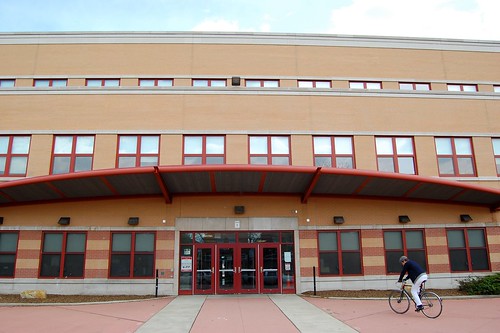
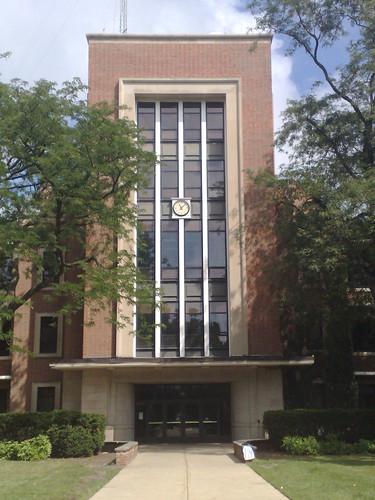
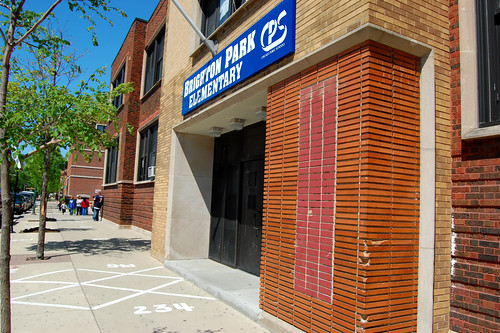
Maybe if we change that thinking, make an equal education a Constitutional right, then we can finally talk about "fixing" public education--by leveling the funding playing field. The pictures above are of 2 elementary schools in the same public school district--the Chicago Public Schools. The disparity in building quality is obvious from the pictures.

Think about where you live. Within your school district, are the schools in one neighborhood nicer than those in another?  Shouldn't we be offering all of our kids the same opportunities and the same access to education?

Read the Sam Chaltain piece here: Sam Chaltain: Other People's Children

Jan 8, 2012

Schools, Finland, Equity, #Occupy


Image via Wikipedia
When I was in college I read the book Savage Inequalities by Jonathan Kozol.  The book, released in 1991, was a startling look at the inequities among public schools. Sometimes the inequities Kozol describes are really hard to read about. Dilapidated school buildings exist on one side of a river while shiny, well-kept buildings exist on the other side of that same river. Why does this inequity exist? Because in the U.S., our public schools are funded mostly by local property taxes. A nice neighborhood with a large tax base will have the funding to make a really nice school building, keep it well-maintained, offer a wide variety of programs, and be up-to-date in its technology. An example of such a school is New Trier High School in Winnetka, IL. According to School Digger (a site that reviews and ranks schools nationwide), New Trier is ranked the 5th best school in the state of Illinois.
New Trier High School. Image Credit: Flickr/eszter

Just 30 miles south of New Trier High School in Chicago is the Chicago Vocational High School. According to School Digger, Chicago Vocational ranks 661st in the state of Illinois.
Chicago Vocational School. Image Credit: Flickr/ reallyboring 
What's the difference between these schools besides 30 miles? Poverty. Winnetka is a suburban middle/upper middle class town. Meanwhile, almost 100%  of Chicago Vocational's students live in poverty.

You may think that since Savage Inequalities came out in 1991 and it is now 2012, things have changed. Think again.  Kozols' later book, The Shame of the Nation, published in 2005, says that things have gotten worse. Now it's not just poverty that leads to inequity, schools are also becoming more and more segregated.

Our government has attempted to right these wrongs through a series of legislation--from No Child Left Behind to Race to the Top. Throughout the course of this legislation, I have read articles about other countries that outperform the U.S. in achievement. One of the countries that has garnered a lot of attention in recent years is Finland. An article from the Atlantic, "What Americans Keep Ignoring about Finland's School Success" is circulating widely on Twitter and in the blogosphere. I read this article and  was struck by a few quotes:
"There are no lists of best schools or teachers in Finland. The main driver of education policy is not competition between teachers and between schools, but cooperation."
"Decades ago, when the Finnish school system was badly in need of reform, the goal of the program that Finland instituted, resulting in so much success today, was never excellence. It was equity."
"That this point is almost always ignored or brushed aside in the U.S. seems especially poignant at the moment, after the financial crisis and Occupy Wall Street movement have brought the problems of inequality in America into such sharp focus. The chasm between those who can afford $35,000 in tuition per child per year -- or even just the price of a house in a good public school district -- and the other "99 percent" is painfully plain to see."
As the 1% focus on keeping their wealth, the gap grows bigger between the haves and have-nots. According to Jonathan Kozol's work, increasingly that gap is also marked by color.

An acquaintance on Google + commented that what works in Finland probably won't work in the U.S. because of size differences. It's such a small country, comparatively. My response? New Trier is only 30 miles from Chicago Vocational High School. The population of Winnetka and Chicago combined is roughly 3 million. The population of Finland is over 5 million. I think that if we start small....perhaps by creating equity between schools that are in the same district, maybe expanding to schools that are within 30 miles of each other, we might see some huge differences. I think we owe it to the kids of our nation to try to level the playing field. Don't you?

Oct 30, 2011

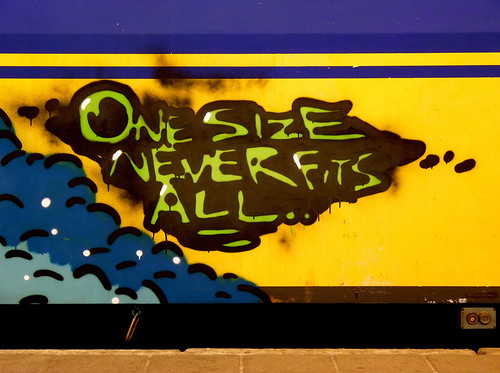
One Size Never Fits All

Image Credit: Flickr/Akbar Sim (voorheen Meneer de Braker)

This week a struggling high school student visited my alternative program asking about how to enroll himself. In a nutshell, here is what he said:
  • I am a senior and I really want to graduate this year.
  • I struggle with reading and writing, but when I ask for additional help from my English teacher she tells me that she's already explained things to the whole class and she doesn't have time to explain it to me again.
  • I am really, really good at math. My teachers just need to show me how to do a problem once and then I can do it in my head. But I've flunked almost all of my math classes because I don't show my work; or when I do, I don't do the problems the same way as the teacher wants them.
  • My school seems to think that one size fits all when it comes to learning...but their ways of teaching don't fit me! I wish I could go somewhere where I could test out of math classes and get extra help in English. I wish I could go somewhere that offered more hands-on learning because I learn better when things are hands-on.
I was so impressed with this student's self-awareness and motivation! He wants to graduate, he knows his academic areas of weakness and his academic strengths, and he knows how he learns best. These are all qualities that will benefit him greatly in the world of work. But in a traditional school setting, those same qualities are forcing him to consider dropping out or getting a GED. There is something very wrong with this picture!

This student is exactly the kind of student I recommend for enrollment in my alternative program---but due to constraints of the educational system, he cannot enroll.  Why? 

The student who visited me does not attend one of our partnering schools.  We are an alternative program not an alternative high school. This means that we do not offer our own high school diploma; instead, we partner with traditional high schools in our area. They dictate the graduation requirements for their students and provide funding to support our offsite program. When students have met all graduation requirements, they receive a traditional high school diploma from their home school.  If this student attended our program, any work completed in our program would be worthless because it would not count toward a high school diploma from a partnering school. 

Why doesn't the school just partner with our alternative program so that this student can earn a diploma? In this case there is one main reason: the school the student is enrolled in has its own alternative program. They don't want to send someone to another district when they have their own alternative classroom. The problem is that their alternative program only offers computer-based instruction for at-risk students. Their alternative program adopts a "one size fits all strategy" that is different from the traditional school's strategy, but still only offers one style of learning for all of the kids enrolled.

It is frustrating for this student to know that there is a program like mine that would offer him choices when it comes to learning, that would offer him more one-on-one assistance if he needs it, and that would allow him to graduate on time with his class--but he can't enroll because he doesn't live in the right district. It is frustrating for me to see a kid who so clearly exhibits qualities that will make him a successful adult, who is motivated to do what it takes, but might not graduate because of school finance and residency issues.

A lot of people talk about school reform. A lot of people talk about issues relating to teachers and how they are paid, about standardized testing and failing schools. But what about the kids? Where is the ed reform plan that focuses on the kids? The student who visited me is one of many, many kids who want to learn, but feel lost in the system. No amount of standardized testing or teacher salary-adjustments will help him be successful in our current educational system. At what point do we stop trying to fix the small stuff and realize that it's time for a system-wide change? 

In my dream world, that student would walk into our school building and be welcomed with open arms. Home address and financial partnerships between districts wouldn't matter. A kid wants to learn and a school wants to help him--that's all that should matter. How can we make that dream come true?


Akbar Sim (voorheen Meneer de Braker)Akbar Sim (voorheen Meneer de Braker

Sep 18, 2011

What if? Thoughts on Ron Clark Academy, Parents and Teachers

In 2009, I attended  the Risky Business Conference for educators who work with at-risk youth. Mr. Ron Clark was the keynoter. I don't think there was a single person in the audience who wasn't captivated by his presentation. He is an entertainer, and both his classroom and his school (Ron Clark Academy) are lively places. Watch this video to see what I mean.


Ron Clark is very innovative. He has a unique style of teaching, leading, and talking about education. The overwhelming quality I sensed in his presentation at Risky Business is passion. He loves what he does and he loves his students.

Looks great, right? Here's some background on the Ron Clark Academy (from the RCA student FAQ page):
  • Potential students must apply while in 4th grade.
  • Approximately thirty 5th graders are admitted each year. Students in grades 6-8 are not admitted.
  • 5th graders are expected to remain in the program for 4 years in order to achieve the greatest success from the Academy's program of study.
  • Average class size is 30 students (these are not all gifted students; a majority have learning or behavioral issues.)
  • It costs money to attend RCA. There is a sliding scale for tuition and many fees are offset by scholarships, but admission may be limited if there are not enough corporate donations or sponsors.
There are many teachers across the country who have a lot of passion. But their passion is sometimes limited by barriers that the Ron Clark Academy has worked hard to break down. Due to corporate donations and sponsorship, RCA has a beautiful building with up-to-date technology. Class size is limited--the school only has about 120 students, on average 30 kids per grade. Those kids stay together for four years, which means they really build a strong sense of community. They have relationships with each other and with their teachers. And I guarantee you, that RCA parents and teachers also get to know each other pretty well. How could they not when they are together for 4 years in such a small school?

Many things strike me about the Ron Clark Academy. First and foremost is that I think the vast majority of teachers and students would thrive in an environment like the one at RCA. With proper resources, a nurturing environment, and lots of stability, amazing things can happen. Throw in high-interest curriculum that engages students' bodies and minds...how can it fail?  

The reality is that most communities and school districts can't break down those same barriers without strong intervention from our government. It would take a great deal of change to make your average public school look anything like the RCA (not to mention a great deal of money.) What can change? On a small in-your-classroom level, teachers/parents/students can work on building better relationships. Education needs to be personal. It needs to be individual. We need to look at each kid for who they are and what they can do and tailor our instruction to meet their needs.

___________________________________________________________
On September 6, 2011 CNN ran a piece by Ron Clark, titled "What teachers really want to tell parents." It caused quite a stir in the Twitter-verse, with both parents and educators taking issue with many of his points. Lots of people have written responses. CNN ran a piece based on comments to Clark's post. Doug Goldberg of Special Education Advisor wrote a piece expressing his frustration with Clark's seemingly antagonistic view of parental involvement that you can read here. In another post about the controversy, 6th grade teacher, Josh Stumpenhorst, reminds us that while there most definitely are some bad parents and some bad teachers, we cannot make assumptions about all parents or teachers. Each individual must be approached as an individual. 

I agree with Josh on that notion of individualizing each educational situation.  That said, I kind of wish Ron Clark had simply sent his letter out to the parents in his Academy. They have a history together, a relationship where such commentary could be like extended family talking after Thanksgiving dinner--sometimes you don't all agree, but in the end you're still family. The rest of us are not a part of that dynamic, not involved in that relationship. I don't know of any other school quite like the Ron Clark Academy. Issues there are not the same as issues in other schools. Most schools don't have the same physical environment (does your school have a slide from the second story to the first?) Few schools have such up-to-date  technology (digital keyboard accompaniment to math songs! and SmartBoards in every classroom!) Most schools don't have such limited class size, and are unable to keep the same small group of kids together for four years. Most schools don't have such a small student:staff ratio (this photo shows 20 staff for about 120 students. Also, note how many teachers of color there are! The staff actually reflects student demographics!) Maybe if we all started out with the same corporate-sponsored structure in place we would have a better chance at creating close enough relationships with parents to say the things the Ron Clark said in his piece. 

Currently in education, we are suffering from a climate of blame. Many teachers blame parents, and many parents blame teachers. One thing many have discovered as a result of the recent Ron Clark controversy is the fact that both groups need to communicate with each other better. There is a common goal here: educating our kids.  The focus should be on how to work together to eliminate barriers to learning; how to turn our schools into strong communities where students, teachers and parents have effective relationships, and are united by a common goal: success for our students. I encourage teachers and parents to reach out to each other--to really listen to each other. Don't blame, and don't assume that what works in one educational situation will work in all situations. Treat each other as individuals. I think that if we all do that, we can start to build relationships, to work together, and to eliminate barriers to learning. What if we all learned to treat each other individually? What if we could stop making assumptions about parents, teachers, students, schools? What if we could truly individualize education? 

Aug 21, 2011

The Power of a Symbol

Several years ago I had a group of students who thought it was "cool" to draw swastikas everywhere. They drew swastikas on their schoolwork, on their clothing, and on their skin. I was horrified. When I asked them to stop, they questioned my motives. "We don't have any Jewish kids here. It's not offending anyone!" I told them it was offending me, and I wanted them to stop.

They did not stop, however. Swastikas continued to appear on their schoolwork and on their skin. One boy used a permanent marker to draw a swastika in the middle of his forehead.  He wore it with pride. He made sure to take off his hat when facing me so that I could see his open defiance of my request. When I looked at him questioningly, asking, "Why did you do that? I asked you to stop." He recited to me the thousands year-old history of the swastika, and assured me (with his blonde hair and blue eyes) that he did not intend for anyone to take it in an Aryan way. He was not a racist or a Nazi, he said.

 
Flickr Image Credit:Wm Jas 
I was deeply disturbed by his insistence that wearing a swastika on his forehead is something to be proud of. The previous year, a different group of students had gone with me to the local nursing home to interview residents about their experiences in WWII.  Their pain was palpable. To have this young man not show any regard for the memory of that pain bothered me immensely. I could only conclude that my student did not know the more recent history of that symbol well enough. As his teacher, it was my job to teach him. I could look at him and say, "YOU are a racist," which would cause him to become more defiant and angry. Or I could try to get him to see things from another perspective.

While thinking about how to approach the subject, I realized that the biggest challenge would be getting these rural, poor, white kids to put themselves in someone else's shoes. I thought about just showing them a movie like Schindler's List.  But that is just a movie. It is so easy to dissociate one's self from a movie; that's not real--it's Hollywood. Instead of a movie, I got the documentary World War II -- The Lost Color Archives. Even with its gut-wrenching scenes from the concentration camps, I didn't think that my students would find much reason to relate to the footage on a personal level.  I struggled to think of a way to make them aware of what the swastika symbolizes to so many people.

My students have all experienced pain. Some of them have experienced so much pain that I am amazed by their ability to survive. The boy with the swastika on his forehead was one such person. His history involves both physical and sexual violence, both of which deeply affected him. Many of my other students had similar backgrounds.

Two days after discovering the swastika-on-the-forehead , I told my students that we were not going to complete any of our regular schoolwork. "We are going to have a discussion. It will be a really serious discussion and I will be sharing some very personal information with you. It is my hope that you will feel comfortable enough to share some things about yourself, too. Because it is so scary to share such personal stories, I need you all to agree to treat each other with respect. If you cannot handle that, you may leave right now. You will not be penalized for leaving. But you will be penalized if you are disrespectful to anyone sharing their personal stories." No one left.

After sharing the story of one of my darkest memories, I asked my students if they had any similar memories. I was shocked by the number of kids who had been living with immeasurable pain. Rape, physical abuse and mental abuse are far more common than I'd ever thought they were. After an intense period of sharing and tears, I asked those who had been brave enough to share, "Are there things that you see, hear, or smell that seem to send you back in time? Do you have flashbacks?" Each one of those kids could name a scent, an object, a song that froze them in fear, making them return in their minds to the time and place they were hurt so profoundly.  I asked a girl who admitted to flashbacks  how she would feel if I played the song that triggered her flashbacks each day as she entered our classroom. I asked the boy with the swastikas how he would feel if I presented him with the trigger to his pain each day. I told them that while the swastika does have an ancient history as a symbol of peace, there are people alive today who will not see it as such. For those people, wearing a swastika is like forcing them back in time to their moment of pain. Then we watched the documentary together.

We wept together. All of us.

At the conclusion of the film I asked them if they now understood why I was so upset by their casual display of swastikas. With red eyes, they all nodded. The boy with the swastika on his head got up to scrub his face in the bathroom. When he returned to the classroom he said, "This was an intense day. Can we have a group hug?" We all stood at the front of our classroom hugging each other for a long time.

That was the single most powerful day of teaching/learning that I've ever experienced in my career.

_____________
For the past week, two things have been on my mind: the movie The Help, and the start of the new school year. The story I just told brings together my thoughts on both subjects.

On The Help:There has been much controversy over both the movie and the book.  I didn't quite understand the controversy until I read this post by Ann Freeman (via Nordette Adams.) I am left wondering: if I read the book, if I see the movie: will I be wearing a proverbial swastika on my head? Am I perpetuating the pain of the past?

On the start of the school year: There is more talk now than ever before about teacher accountability for the learning students do in our classrooms. I just wrote about my most powerful teaching moment--one that deeply affected both me and my students. Yet none of what was taught or learned that day is considered of value in our current educational system. There is no bubble test to measure a student's growth in her/his ability to feel empathy. How do we balance this need for accountability with the need to ensure that kids learn more than just reading and math? For it is my opinion that they also need to learn more about what it means to be human.

Jul 21, 2011

Failure and Success


“Success is dependent on effort.” Sophocles
My whole life I've believed that hard work will lead to success. Not the kind of success that means I'll be raking in the dough, living a life of luxury; but the kind of success that makes me comfortable to live in my own skin, feeling good about myself and the work that I do. No regrets. Inner peace. Satisfaction in a job well done.  

I want my children to achieve success--not necessarily the kind that is measured in dollars and cents or popularity, but the kind that comes from knowing they have put forth their best effort and achieved a goal. Self-satisfaction, happiness, and continual growth are what I wish for them. To help my children become lifelong learners who know what it means to try their best, I send them to school. Most Americans send children to school so that they can learn and succeed. But how do we measure learning and success in schools?

Some rights reserved by Wayan Vota
Schools are places where teachers and students put in tremendous amounts of effort each and every day. Kids try their hardest to learn and achieve. Amazing things happen in classrooms where teachers are passionate, and they work closely with their students. A student can start the school year only able to read 10 words and end the year able to read hundreds. She can start the year not knowing how to complete a long-division problem and end it knowing how to solve any long-division problem she sees. Miracles of learning happen every day in classrooms all over the world! Yet in our current education system, those miracles don't always count as successes.

According to current U.S. educational policy,  a child who learns long-division after months of struggling is not necessarily a successful student. The teacher who patiently helped that student learn, trying multiple teaching strategies, never giving up until she found the right one, is not necessarily a successful teacher. A school that is filled with students and teachers who grow together, performing miracles of learning each day, is not necessarily a successful school. Why? Because our government doesn't count any educational success that can't be measured by a standardized test.

The Elementary and Secondary Education Act (currently known as No Child Left Behind) requires schools to test their students each year and report their test scores to the federal government. Every student in every school is supposed to meet government mandated proficiency levels. Any school receiving Title I funds and not meeting those proficiency levels is required to notify parents, and give them the opportunity to transfer their children to another school that is meeting proficiency requirements.

  Some rights reserved by Matthew McVickar
According to the government guidelines, by 2014 all students are supposed to be at 100% proficiency. That means everyone will be perfect. Everyone will be successful because all kids in the U.S. will be getting perfect scores on their standardized tests...and if they aren't? Those schools that do not achieve 100% proficiency will be sanctioned. They might get shut down. Those teachers might get fired. And those kids? They will be failures who attended a failing school. They will get a new staff or get bussed to a new school in hopes that they will eventually pass the test. Forget about the miracles of learning, the tremendous effort, or the amazing growth they've shown. If it can't be measured on a test, it doesn't count as success.

Across the country this month, schools that receive Title I funds and are not meeting proficiency on standardized tests will notify parents that they are failing to meet the government requirements. Parents receiving those letters will have the option to transfer their children to another school. If you are a parent who receives such a letter, I encourage you to talk to parents in your neighborhood, call the principal at your school, and find out what goes on in classrooms. You are bound to find examples of success that can't be measured once or twice a year on a standardized test. Look for proof that students are growing and performing daily miracles of learning.  Ask yourself--how do I measure success? Is your definition of success based on standardized test scores? Is your child's success dependent upon how they do at filling in bubbles? Was your success measured in that way? 

If there is more to your definition of success than test scores, consider staying in your neighborhood school and celebrating the incredible effort put in by hardworking students and teachers every day. Celebrate the real successes--the kind that come from doing the best you can... rather than the kind that come from filling in the dots on a score sheet.

Vincent Van Gogh said,
 "Happiness...it lies in the joy of achievement, in the thrill of creative effort."
I agree.  I want to measure my children's success by their happiness and growth...not by their test scores. 

How do you measure success?

_________________________
***Note*** Three states (ID, MT, SD) refuse to sanction schools who don't meet the standards set by NCLB. They may lose federal funds, but they will no longer have to measure success by standardized test scores. This article discusses those states and their decision.

Mar 26, 2011

Bob Dylan and the Student-Centered Classroom


I define nothing. Not beauty, not patriotism. I take each thing as it is, without prior rules about what it should be. --Bob Dylan

This quote was originally tweeted by @fear2love and it really struck a chord with me. In particular, I liked how it could apply to education.

Check it out with one minor change:
I define nothing. Not beauty, not patriotism. I take each student as she/he is, without prior rules about what she/he should be.

I think most teachers are already thinking this way or are moving towards thinking this way. But there are others who are still terribly teacher-focused  instead of being student-focused. In simplest terms, those teachers need to realize that without students, they would have no purpose. It is the students who make up the school. Without them, a school is just an empty building.

Mar 6, 2011

The Problem with Schools Today

Image Credit: Flickr/alyssalaurel

The main problems for students in schools today don't involve teacher tenure systems or collective bargaining rights. The biggest issues don't have anything to do with standardized test scores, uneasy feelings about the adoption of a core curriculum or standards-based assessments. Those problems do exist, but they are not student problems. They are teacher problems and those teacher problems are all we hear about in the news anymore. Whatever happened to the importance of the kids?

Deep in the trenches of a high school classroom, I can tell you that these are the problems students  have:
  • poverty, and a growing number of unemployed or under-employed parents who can't provide them with basic needs or pay for driver's education classes
  • addiction (to alcohol, drugs, and/or video games)
  • personal conflicts with other students based on statements made in cyberspace (via text, Facebook or cellular conversations)
  • lack of opportunities for part-time jobs
  • lack of resources that allow them to even consider post-secondary education/training as a possibility
  • the desire to escape from pressure (familial, school, societal) by participating in illegal and/or unhealthy activities (parties, unprotected sex)
HEY...MEDIA...CAN WE GET SOME ATTENTION TO THESE PROBLEMS IN EDUCATION??? I truly wish that a group as large the group of public employees in Wisconsin would take a stand for our students. Let's picket for an end to poverty and addiction! I will happily give up the annual increase I receive from collective bargaining if someone can tell me how to help my students recover from addiction or find a way to help them feed themselves on a daily basis.

Mar 5, 2011

When the Lights Go Out

Image Credit: Flickr/Joriel "Joz" Jimenez

I came across a blog post from the Daily Kos in my Google Reader feed. It was entitled I Don't Want to be a Teacher Any More by writer thalli1, a veteran teacher who recently came to the realization that ever-dwindling resources coupled with ever-growing prescribed curriculum mandates and job duties just don't make teaching worth it anymore for her. She describes in detail the challenges that teachers face each day and says, "then one Thursday, on the eighth day of my 35th year of teaching, I suddenly thought for the very first time ever, 'I don’t want to be a teacher anymore.'  It’s so weird how it just came over me like that."

This post struck a chord with a lot of people. I've read countless blog posts and articles about teachers who are fed up with the current state of education and those most fed up are the ones most affected by thalli1's post. It also struck a chord with me, but for different reasons.

I work in an alternative high school program where the vast majority of my students  come from situations of poverty. Our program has rarely had the budget to cover more than salaries. We've never had up-to-date (or even enough) technology, never had a custodian who works even half-time, and never had a majority of kids come to school well-fed and well-supported. It has always been part of my job to clean my classroom, unplug clogged toilets, shovel snow, serve lunch and chauffeur my students around. Part of me wants to tell thalli1 to buck up: welcome to the real world! 42% of kids in the U.S. live in poverty and almost half of the teachers in this country have been doing what you're complaining about for their entire teaching careers!  But there's another part of me that is just so saddened to read about thalli1's grief. She is losing something in life that she loves--her passion for teaching. I can't imagine how it would feel to lose my passion.
    I have seen the light go out in the eyes of veteran teachers. I have told myself that I will have the common sense to take myself out of the game before it happens to me. I don't want to be the old quarterback clinging to the thrill of the game even though I can no longer make the plays. But when the time comes, how will I know? How will I know that I am failing my students? Will I be able to resist the lure of the full pension, the 600 sick days, the 35 year pin? I hope that I have the good sense to get out before number of years on the job becomes more important than the lives of the kids in my classroom.

    Feb 15, 2011

    Why I LOVE Public Education

    It's time for a positive public relations campaign! We need to make sure the public hears what is GREAT about our public schools! I am limited to my own experience as a student, teacher, and a parent and I realize that not everyone has the same experience in public schools; but here's what tops my list of public school JOYS:

    • KIDS!  When I was one, I didn't always fit in, was at-risk in junior high and high school, and didn't always love school. But in retrospect, I am so grateful for my time in public schools. I grew up in suburban Chicago and attended an elementary school with a lot of diversity (100+ languages spoken!) There was always a peer who who helped me and a group of friends that I considered my second family.  As a parent in Iowa,  my children attend a public school with a similar demographic to my old elementary school (yes, in Iowa!)  This huge mix of culture and diversity really prepares them to be global citizens. They learn about the world through their interactions with their peers. As a teacher, I love my students! We become a little family, sharing chores that keep the classroom running, sharing learning and sharing conversations. They are so smart and so funny sometimes that my time with them very rarely feels like work.
    •  COMMUNITY-BUILDING! It starts in the classroom, where students and teacher become a little community. It spreads to a building, and if you're lucky, it moves throughout a district and/or a town. My students partner with the community in several projects each year. They are all labeled "at-risk" of dropping out and the "bad vibes" go both ways: they don't like most adults in the community and most of those adults don't like them. Community projects help everyone be more accepting of each other. As a parent, I want to see more of this at my children's school: we have such a wonderfully diverse population and if we interacted more we could all learn to appreciate and celebrate that fact! Where else can such community building occur but in a public school?!?
    • GLOBAL VILLAGE-BUILDING! We start by building small communities, but why stop there? So many kids in my classroom and in my neighborhood suffer from poverty. They don't get to go on vacation or see the world outside of their towns and they don't even have access to technology to see the world via the Internet. I LOVE the fact that public schools can give students the opportunity to look out a window to the world. A small field trip, a guest speaker, a Skype meeting with someone halfway around the world, or an introduction to a Google app: any of these things we do in our public schools can show kids the world outside. If they can see a glimpse of the world outside of their hometown, then they can dream a better life.
    • HOPE! In my professional life, I have seen some kids who are really beaten down by personal traumas and tribulations. By the time I see them, they have sometimes suffered for fourteen or more years. But despite all of that suffering, most of them still have hope! They still want to learn! They still come to school each day and get that twinkle in their eye when they understand something! They can still laugh! When I see these kids not only survive, but succeed, it is hard not to LOVE my job and LOVE public education--without it, none of the above would be possible.

    Feb 14, 2011

    A Message to my Fellow White Educators

    I am relatively new to Twitter, but in a very short time I’ve become really interested in the discussions about education reform. There are two obvious camps that I can see involved in regular debate: the teacher/union/testing is bad camp vs. the Race to the Top/get rid of bad teachers/testing is the best tool available camp.  I’ve tried to become active in those conversations by sending messages, posting comments on blogs and retweeting, but the conversation never starts because no one writes back to me. I commented on an Edutopia blog and the blogger responded to every other commenter except me. That isn’t much of a conversation! Since then, I have had similar experiences when posting comments on other blogs. First, I had to wonder if my comments were written in invisible ink. Then I started to think there is some sort of technical difficulty. Do I have some sort of electronic plague? Then I began to think about what I have been talking about. Maybe something I say makes people uncomfortable? I thought and thought, and talked to my husband about it (a face-to-face conversation!) He pointed out to me that I regularly bring up issues relating to race and poverty. BINGO, I thought. The education reformers I’ve been trying to engage in conversation are white.

    In real life and on Twitter, I find that most white folks don’t want to talk about race and ethnicity issues when they talk about education. I’ve heard white people say time and time again, “If I talk about race, people are going to think I’m a racist.”  But here’s the deal: if you don’t start talking about the fact that most of our “failing” schools are filled with African-American and Hispanic students, then you are not talking about education reform. If you do not acknowledge that race and ethnicity are directly related to poverty in our country, you are not talking about education reform. And if you don’t see the correlation between race/ethnicity and poverty--the single most important issue affecting student success in education--then you are not talking about education reform. If you are afraid to speak about the role race/ethnicity plays in our education system, then your inaction speaks louder than words.

    We may have elected a person of color as president, but we still have racial problems in our society. When a black mom is jailed for enrolling kids in a higher achieving school, while at the same time thousands of white families across the country have done the same thing and have not been jailed--we have a problem. We need to open up the dialogue about the role race and ethnicity play in education.

    To my white colleagues in education reform I say: Stop worrying about whether people will question your liberal sensibility. Stop worrying that someone will think you’re a racist (if that’s what’s stopping you) By not speaking out you are a bystander who is letting injustice happen and becoming exactly what you are trying not to be. We need to have open conversations about race and ethnicity and the impact they have on education. We need to prepare ourselves and our children for the future--because the time is coming where whites will be the minority. Change is coming, whether you want it or not. Prepare yourself by talking about it now.

    ShareThis

    Related Posts Plugin for WordPress, Blogger...