Showing posts with label failing schools. Show all posts

Jan 29, 2012

Other People's Children

Image Credit: Flickr/ 77krc
I recently read a piece by Sam Chaltain in the Huffington Post that had me shaking my head at the problem he exposes, and yelling "YES!" his suggested solution.

I find Sam Chaltain's piece to be a harsh reflection of reality, not just in the Ohio school district he writes about; but also in the school district where I live. People worry about educating their own children; but when it comes to educating ALL children...OUR nation's children...most people don't seem to care. Collectively, our society doesn't seem to worry about other people's children. Our education policy reflects that lack of feeling. That is why one school can be 30 miles from another geographically, but light years away when it comes to programming, achievement, and even structural integrity.

Image Credit: Flickr/reallyboring

Image Credit: Flickr/reallyboring 
Chaltain writes,
"Indeed, public education is our surest form of 'national security.' It provides the most likely path out of poverty, helps prepare young people to be successful workers and citizens, and reminds us all of who, on our best days, we aspire to be. And yet the reality is we continue to tolerate a system in which your zip code determines your access to the American Dream, and in which communities refuse to fund their schools because 'their' children no longer go there."
Equality in education is something we, as a nation, thought we achieved in 1954 with Brown v the Board of Education. Yet as Chaltain writes, a Texas case in 1974 challenged the constitutionality of funding schools by property taxes because that process leads to unequal schools. The Supreme Court ruling decided that education wasn't a Constitutional right.

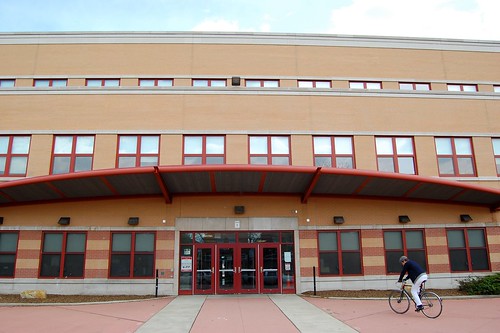
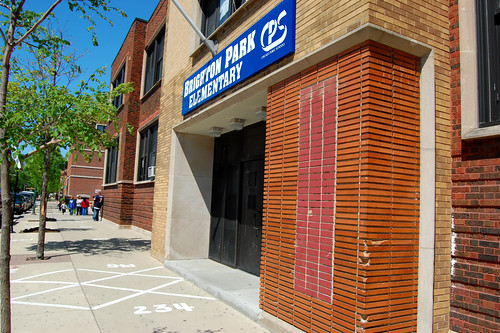
Maybe if we change that thinking, make an equal education a Constitutional right, then we can finally talk about "fixing" public education--by leveling the funding playing field. The pictures above are of 2 elementary schools in the same public school district--the Chicago Public Schools. The disparity in building quality is obvious from the pictures.

Think about where you live. Within your school district, are the schools in one neighborhood nicer than those in another?  Shouldn't we be offering all of our kids the same opportunities and the same access to education?

Read the Sam Chaltain piece here: Sam Chaltain: Other People's Children

Jan 8, 2012

Schools, Finland, Equity, #Occupy


Image via Wikipedia
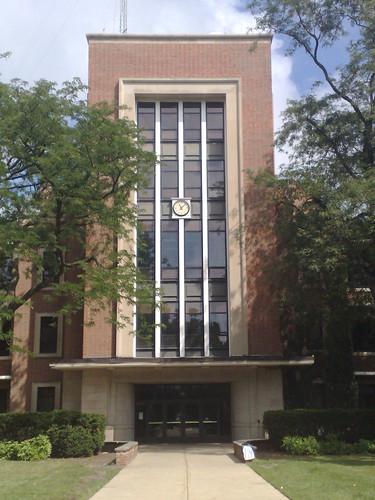
When I was in college I read the book Savage Inequalities by Jonathan Kozol.  The book, released in 1991, was a startling look at the inequities among public schools. Sometimes the inequities Kozol describes are really hard to read about. Dilapidated school buildings exist on one side of a river while shiny, well-kept buildings exist on the other side of that same river. Why does this inequity exist? Because in the U.S., our public schools are funded mostly by local property taxes. A nice neighborhood with a large tax base will have the funding to make a really nice school building, keep it well-maintained, offer a wide variety of programs, and be up-to-date in its technology. An example of such a school is New Trier High School in Winnetka, IL. According to School Digger (a site that reviews and ranks schools nationwide), New Trier is ranked the 5th best school in the state of Illinois.
New Trier High School. Image Credit: Flickr/eszter

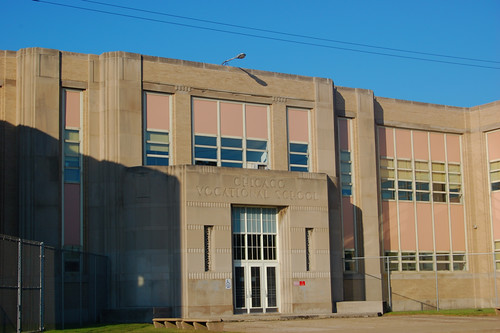
Just 30 miles south of New Trier High School in Chicago is the Chicago Vocational High School. According to School Digger, Chicago Vocational ranks 661st in the state of Illinois.
Chicago Vocational School. Image Credit: Flickr/ reallyboring 
What's the difference between these schools besides 30 miles? Poverty. Winnetka is a suburban middle/upper middle class town. Meanwhile, almost 100%  of Chicago Vocational's students live in poverty.

You may think that since Savage Inequalities came out in 1991 and it is now 2012, things have changed. Think again.  Kozols' later book, The Shame of the Nation, published in 2005, says that things have gotten worse. Now it's not just poverty that leads to inequity, schools are also becoming more and more segregated.

Our government has attempted to right these wrongs through a series of legislation--from No Child Left Behind to Race to the Top. Throughout the course of this legislation, I have read articles about other countries that outperform the U.S. in achievement. One of the countries that has garnered a lot of attention in recent years is Finland. An article from the Atlantic, "What Americans Keep Ignoring about Finland's School Success" is circulating widely on Twitter and in the blogosphere. I read this article and  was struck by a few quotes:
"There are no lists of best schools or teachers in Finland. The main driver of education policy is not competition between teachers and between schools, but cooperation."
"Decades ago, when the Finnish school system was badly in need of reform, the goal of the program that Finland instituted, resulting in so much success today, was never excellence. It was equity."
"That this point is almost always ignored or brushed aside in the U.S. seems especially poignant at the moment, after the financial crisis and Occupy Wall Street movement have brought the problems of inequality in America into such sharp focus. The chasm between those who can afford $35,000 in tuition per child per year -- or even just the price of a house in a good public school district -- and the other "99 percent" is painfully plain to see."
As the 1% focus on keeping their wealth, the gap grows bigger between the haves and have-nots. According to Jonathan Kozol's work, increasingly that gap is also marked by color.

An acquaintance on Google + commented that what works in Finland probably won't work in the U.S. because of size differences. It's such a small country, comparatively. My response? New Trier is only 30 miles from Chicago Vocational High School. The population of Winnetka and Chicago combined is roughly 3 million. The population of Finland is over 5 million. I think that if we start small....perhaps by creating equity between schools that are in the same district, maybe expanding to schools that are within 30 miles of each other, we might see some huge differences. I think we owe it to the kids of our nation to try to level the playing field. Don't you?

Mar 13, 2011

Don't Blame it on DIBELS

Earlier today, @DianeRavitch tweeted "Children arrive in kindergarten with gaps between them, based on family income, engagement. Teachers didn't cause that gap."

A short time later, Aaron Thiell (@althiell) tweeted "@DianeRavitch Kindergarten should be a year of bedtime stories savored among new friends, not DIBELS nonsense word fluency & stop watches."

Diane Ravitch's main point may be that teachers are not to blame for poverty and other outside factors that cause children to lag behind in school, and thus they should not be blamed for student's failure to perform on high-stakes tests. But DIBELS are not high-stakes tests. In fact, DIBELS and other curriculum based measurements are some of the only academic tools teachers have to close the the achievement gap.

Like Diane Ravitch tweeted, teachers can't be blamed if students come to their classrooms without the prerequisite skills needed for success in school. We can't be blamed if students come to school hungry, sleep-deprived, or emotionally scarred any more than we can take credit if they enter our classrooms already able to perform at or above proficiency. All kids are different when they enter our classrooms, and that difference is probably the single-most challenging part of classroom teaching. It is impossible for teachers to ensure that all students enter our classrooms with the equal access to basic needs. It is impossible for us "to fix" the many environmental and genetic factors that predict success in school. The only thing we can control is how we teach.

How do we know how to teach when every student comes to us with a different set of abilities? There are two main ways:
  1. We can try to get to know each student by talking to them and closely examining their work. We can build individual relationships with each child that are so strong that we recognize when they are at frustration level, when they are confused, or when they are understanding concepts so well that they are ready to move on.
  2. We can use curriculum-based measurements (like DIBELS) to get quick and easy measurements of a students reading, writing, or math levels and take the guesswork out of figuring out what skills the student has when they enter our classrooms. 
Option number one is really only plausible in a classroom with few students and a lot of time available for one-on-one instruction. Option number two is plausible anywhere. When curriculum-based measurements are used correctly, they eliminate the negative effects of outside factors over which teachers have no control.

Here's a hypothetical example:
J.D. is a third grade student who comes to school hungry and tired. His mom is a single parent who works 2 part-time jobs but still doesn't make enough money to support her four children. They live in a low-income housing complex that is riddled with crime. J.D.'s two oldest siblings have dropped out of school, and unless something changes J.D. and his younger sister will end up doing the same. His classroom teacher has been trying to help J.D. be successful, but she can't seem to get through to him. He is easily frustrated in class and as a result he has a lot of behavior issues. She thinks about what would make J.D. successful: a two-parent household, higher wages for his mother, a nicer place to live, positive role-models in his neighborhood. She feels helpless because she can't do anything about those things. It's not her fault J.D. is failing and there is no way for her to help him. She worries because there is no way to get J.D. to perform at grade-level on high-stakes tests when he comes from such an impoverished background. As a result of circumstances that are beyond her control, she may lose her teaching job.

In this hypothetical situation, the teacher is right: there is no way to help J.D. if we blame all of his problems on things that are happening outside of school and beyond our control. We can refer him to social services and send him to a breakfast program before school, but there is still a chance that his family won't follow through on obtaining any of those services. Does that mean that J.D. is unteachable? That we should give up? That his situation is so bad that he will never be able to learn? ABSOLUTELY NOT. Scores of people have overcome situations of poverty to become successful. Teachers need to stop feeling helpless and use the tools that available to us to teach our students, no matter what skills or deficiencies they enter the classroom with. How can we do that? Using curriculum-based measurement (CBM) is a really good option.

Unlike high-stakes testing, CBM is what it stands for: measurement that is based on the curriculum. Students are assessed on skills they've actually been learning in the classroom, not on skills that a corporate test-maker decided all third graders should know. CBM allows a teacher to quickly find out what skills a student has when they enter her classroom by giving one or two-minute assessments in content areas such as reading or math. When a student's current level is assessed, the teacher can gear instruction for that level. Repeat measurements can be done weekly, monthly, or quarterly to monitor progress and then adjust the level of instruction if necessary. There is no guessing about what level a student is performing at or worrying about why they are at that level--teachers simply use current information to make decisions about instruction. When using CBM properly, teachers only have to worry about things over which they actually have control--how they teach and what level of curriculum they use with each student to do that teaching. I can't adjust a student's home life; I can adjust my instructional decisions.

Here's another possibility in the hypothetical situation of J.D. and his teacher:
J.D. still comes from the same situation of poverty. His teacher still wishes that there was something she could do to make his life easier. She brings snacks for her class each day so that they at least have a full belly when school starts.  Within the first month of school she administers a reading probe (like DIBELS) to each of her students to see what their current reading level is. She spends a little over ten-minutes with J.D. to find out his instructional level in Oral Reading Fluency (ORF.) She discovers that despite the fact that J.D. is in third grade, he is barely reading at a first grade level. She adjusts her instruction so that J.D.'s reading group materials fit his level and he receives one-on-one instruction using first grade reading passages. The passages are challenging for J.D., but he's not so frustrated that he has behavioral outbursts. His teacher graphs J.D.'s progress and shares the graph with him. Their goal is to help him be able to read a third grade passage without getting frustrated. She spends 2-5 minutes each week checking on his progress and sharing the results with him. He feels good because he can see that he is becoming a better reader and she feels good because she is making a difference. She still worries because J.D. is not proficient in third-grade reading and won't pass the high-stakes test. But if the district penalizes her for his scores on the high-stakes test, she has proof that she made a difference--the CBM scores show that J.D. has made growth and jumped up almost 2 grade levels in reading for the year.

Not all standardized tests are bad. By the same token, not all CBMs are used properly. But when curriculum-based measures like DIBELS are used properly, they can be a valuable tool both for students and for teachers. CBM can level the playing field for students who come from situations of poverty by giving them a chance to receive individualized instruction that will help close the achievement gap.

Mar 5, 2011

When the Lights Go Out

Image Credit: Flickr/Joriel "Joz" Jimenez

I came across a blog post from the Daily Kos in my Google Reader feed. It was entitled I Don't Want to be a Teacher Any More by writer thalli1, a veteran teacher who recently came to the realization that ever-dwindling resources coupled with ever-growing prescribed curriculum mandates and job duties just don't make teaching worth it anymore for her. She describes in detail the challenges that teachers face each day and says, "then one Thursday, on the eighth day of my 35th year of teaching, I suddenly thought for the very first time ever, 'I don’t want to be a teacher anymore.'  It’s so weird how it just came over me like that."

This post struck a chord with a lot of people. I've read countless blog posts and articles about teachers who are fed up with the current state of education and those most fed up are the ones most affected by thalli1's post. It also struck a chord with me, but for different reasons.

I work in an alternative high school program where the vast majority of my students  come from situations of poverty. Our program has rarely had the budget to cover more than salaries. We've never had up-to-date (or even enough) technology, never had a custodian who works even half-time, and never had a majority of kids come to school well-fed and well-supported. It has always been part of my job to clean my classroom, unplug clogged toilets, shovel snow, serve lunch and chauffeur my students around. Part of me wants to tell thalli1 to buck up: welcome to the real world! 42% of kids in the U.S. live in poverty and almost half of the teachers in this country have been doing what you're complaining about for their entire teaching careers!  But there's another part of me that is just so saddened to read about thalli1's grief. She is losing something in life that she loves--her passion for teaching. I can't imagine how it would feel to lose my passion.
    I have seen the light go out in the eyes of veteran teachers. I have told myself that I will have the common sense to take myself out of the game before it happens to me. I don't want to be the old quarterback clinging to the thrill of the game even though I can no longer make the plays. But when the time comes, how will I know? How will I know that I am failing my students? Will I be able to resist the lure of the full pension, the 600 sick days, the 35 year pin? I hope that I have the good sense to get out before number of years on the job becomes more important than the lives of the kids in my classroom.

    Jan 23, 2011

    Fleeing from Schools in Need of Assistance

    The No Child Left Behind Act (ESEA) may get a name change soon but one thing seems like it will remain: standardized, norm-referenced testing.

    I am frustrated, on many levels, by norm-referenced bubble tests. First on my list of frustrations is the negative effect of the law's attention to subgroups. In case you are not familiar with subgroups, let me explain: each school district must report their students' test scores in a disaggregated fashion, listing the scores in ten groupings. The groupings are designated as follows: All Students, 5 ethic groups (American Indian, Asian, Hispanic, Black, and White) and Limited English Proficient, Special Education, Migrant Status and Free and Reduced Priced Lunch.  95% of all students must be tested, but if a school isn't large enough to have a significant population in a subgroup, they do not need to report scores for that subgroup.

    I understand that the purpose of this part of the law was to ensure that members of these subgroups are receiving a quality education and are not lagging behind their oftentimes more advantaged peers. But in my experience, reporting the scores of these subgroups can lead to anxiety, anger, divisiveness, and the occurrence of a phenomenon called "white flight.


    My city is suburban; it is a part of a thriving and diverse area surrounding a state university. There has always been diversity because of the university--graduate students from around the world come here to study.  People here are used to having a mobile population of educated families moving in and out of our neighborhoods and schools. We have all enjoyed the way these families from abroad give our Iowa town a more urban flavor, make us feel more like citizens of the world than just citizens of our state. But in the past 5-10 years, the diversity here has changed; the mobility no longer comes just from international students. We've had an influx of people from Chicago who come to Iowa to find a better life for their families. Housing here is more affordable, schools are excellent, and there is very little violence or crime compared to Chicago. The problem is that many members of our community are not comfortable with our our newest residents. They bring their culture with them and it is different. For some people this difference is wonderful; for others it is frightening. We now have some very colorful neighborhoods, some schools where 50% or more of the student population is not white. Many of our newest students are African American.


    When new students enroll in schools in Iowa, we find that many are not reading at the same level as students who were born here.  Our schools do an excellent job of intervening to help struggling learners grow; but in many cases the growth is not great enough to meet the proficiency requirements of NCLB (known as Adequate Yearly Progress.) Failure to meet AYP happens most often my community's most diverse schools.  As a result, schools with a lot of diversity are now labeled Schools in Need of Assistance (in other states they are called failing schools.) The local newspaper publishes the disaggregated results of norm-referenced tests for these "failing" schools. Members of our community see that in some instances it is the subgroup of African American students who are not achieving well enough on the state test. They hear about schools devoting resources to help these students achieve proficiency. Instead of supporting the efforts of the schools, they worry that all the resources are being devoted to "those kids," that their own children are being left behind.

    Any school not making Annual Yearly Progress is required by federal law to offer parents the opportunity to transfer their children to another school. I believe that the intent of the law was to allow members of subgroups the opportunity to move their children from a low-performing school to a school that would offer them a greater chance of success. However, I do not believe that this intent has been carried through to standard practice.  The people who transfer to new schools are not members of underachieving subgroups in low-performing schools; in fact they are the highest achieving students. They are not leaving low-performing schools: the average ACT score for high schoolers in our district is 25.6. These transfer students are leaving the most ethnically diverse schools. 

    The five most diverse schools in our district have been on the SINA list for the past two years.  As a result of being on this list they have been required by federal law to offer students the opportunity to transfer. They have lost students for two years and as a result of decreased enrollment they have lost teachers, too. The students they lose are the highest achieving students.  These high achieving students leave and scores drop again. Their transfers set up a cycle of low scores that will eventually lead to state intervention if we do not put a stop to it. Schools serving our most diverse neighborhoods will be forced to close. The law that was created to keep our students from being left behind will be the cause of their school's demise.

    I do not know how to solve this problem. I don't know how to convince my neighbors that our neighborhood school is still filled with highly qualified teachers who are doing everything in their power to make sure that ALL students are learning and growing. The school my children attend filed their SINA plan in October and I had the privilege of reading it and offering feedback. The faculty there is vigilant in their efforts to help all learners achieve proficiency. This year they are differentiating instruction and using curriculum based measurements to track student growth. Even though their AYP on norm-referenced tests may not reflect the growth they're seeing, we already have evidence that students are growing and making progress this year. I hope that someday our legislators and neighbors will look at this growth and support it, that they will accept the changing landscape of our community and appreciate the richness it offers. If they do not, No Child Left Behind will ironically be the cause of that which it attempted to stop--the failure of our most at-risk children.

    ShareThis

    Related Posts Plugin for WordPress, Blogger...