Aug 7, 2011

The Visitor: a review


The name of this blog comes from the Greek language. Empatheia means passion, and it is one of the roots of the English word empathy. Empathy is the ability to identify with or experience the thoughts or feelings of another person.  In all aspects of culture (literature, film, art, food, and language) I am inspired by creations that challenge me to view the world through a new lens. Learning occurs at those moments when my eyes are opened, when I become cognizant of something I never before considered. It begins with a trickle of awareness and then slowly grows into a flow of questions, encouraging me to ask for more information.

I enjoy learning. I enjoy seeing things from another perspective. I take to heart that Native American proverb stating, "Before you judge another man, walk two moons in his moccasins." I look for learning opportunities that help me see the world as a child--with a newness that sparks my imagination, and makes me ask questions. The film The Visitor created such an opportunity for me.

In The Visitor, Walter Vale is a widowed college professor in Connecticut. From the very start of the film, it is obvious that he is in a slump. The class he teaches is filled with glazed-over eyes, a student complains that they have not yet received the syllabus--despite the fact that the due date for their first big term paper already passed. We see Walter whiting out the date on a previous year's syllabus, readying it for redistribution just before he heads to New York City. In NYC, he will be staying in his second home, an apartment, while presenting a paper at a conference on the economics of third world countries. Upon arriving at his apartment, though, he discovers a young Senegalese woman in his bathtub. Zainab thinks that Walter is there for some nefarious purpose and begins screaming in French. Walter backs away and is met by Zainab's Syrian boyfriend, Tarek, who has returned to the apartment just in time to defend his girlfriend from her "attacker."  Walter explains that the apartment is his, and proves it with his keys. The young couple says they rented the apartment from someone named Ivan, who apparently set them up as squatters while Walter taught in Connecticut. Zainab and Tarek gather their belongings and head out to find another place to stay.

Walter looks around his apartment after they leave, and notices a photograph of the couple that was left behind. He decides to seek them out to return it, finding them on the street calling friends and looking for a place to spend the night. Walter stands silently by the couple and you can see the wheels in his brain turning. Eventually, he invites them back into his apartment to stay. With that decision Walter's journey of two moons in another man's moccasins begins.

The film is the story of an awakening--not just for Walter, but also for the viewer.  Walter is made aware of several aspects of both Syrian and Senegalese culture. He also begins to see parts of NYC that he's passed by a multitude of times, but never taken the time to really see. Tarek opens his eyes to a new world, a new way of thinking, and Walter becomes alive again. It is a beautiful story of friendship that becomes horribly complicated when we learn that Tarek is an undocumented citizen. The audience is then awakened to what it is like to live in the U.S. without the proper paperwork.


This is a very touching and thought provoking film. The trailer states, "You can live your whole life and never know who you are until you see the world through the eyes of others." That quote not only beautifully describes the experiences of Walter in the story, but it also captures the experience of those who watch the film: allowing a spark to ignite, allowing questions to form, allowing voices to be heard. I highly recommend this film to anyone who loves to learn, who is willing to see things from a new perspective.

If The Visitor gives you a trickle of awareness that slowly grows into a flow of questions, I encourage you to ask for more information. Visit the Federation for American Immigration Reform to learn more about immigration policy and reform in the U.S.

Special thanks to my mom for recommending this film to me. 

Aug 3, 2011

We DO Need Another Hero!!!


CC photo credit: Oscar J Baeza 
Up, up and away web! Shazam!  Go! Go! Go web, Go! 
He jumped on to the coffee table reciting those lines, mimicking the actions of his favorite superhero, the Amazing Spider-Man!

Since the age of two, my son has been a huge fan of superheroes: Spider-Man, Superman, The Flash, The Thing, The Incredible Hulk and almost every generation of Power Rangers. It seems like every superhero ever created eventually made their way into our home in the form of an action figure. At age three he started martial arts classes. The reason for the classes? Superheroes need to know how to defend themselves! At age four he started soccer and baseball. Why? Because superheroes need to know how to run fast and be coordinated! Any sport he was old enough to play, he joined...because those sports were a part of his self-imposed training regimen--the one required for him to become a real life superhero.

He loved watching and reading about superheroes who are always on the side of justice, always fighting to stop the spread of evil, always focusing on ways to make the world a better place (even though that is not always an easy job. "With great power comes great responsibility," he would say.) He watched the original Superman cartoons from the 1950's, read the original Marvel Spider-Man comics, was a different superhero each year for Halloween, and had superhero pajamas for every night of the week. Bath time was about more than getting clean... It was always an epic battle between Justice League action figures and  Lego bad guys, where the fate of humanity rested in the  heart of one superhero--my son!

All rights reserved jenmardunc


copyright jenmardunc

It has been a pleasure to tease my now 6th grade son about the origins of his interest in sports! But honestly, he doesn't much mind the teasing. He still enjoys superheroes! This summer he saw Thor,  went to Captain America on opening night and watched several seasons of Smallville during our epic heat wave. These heroes still capture his imagination and make him dream about how he can make the world a safer, happier place.

There has only ever been one problem with his love of heroes: none of the mainstream superguys look like him. Green Lantern from the Justice League was the only brown-skinned hero in his collection of action figures. Recently he discovered the show Heroes on Netflix and was interested to see some people with powers who were not white (the Haitian, Hiro and Ando). He liked the Will Smith movie, Hancock, when he saw it. But that's about it. (Before any die-hard comic book fans argue, I will acknowledge the fact  that there have been other black heroes, but those heroes have never been marketed in a big enough way for my son to know about them. Those characters are never featured in kid-appropriate tv shows or movies, either.)


Marvel
So, I was excited to learn about the latest incarnation of Spider-Man in The Ultimate Spider-Man series. This version of Spider-Man is biracial, just like my son. The new Spider-Man is half black and half Latino, and his name is Miles Morales. I am absolutely thrilled that my son, whose lifelong dream is to serve humanity on the side of justice, can see a superhero who looks like him! But apparently, not everyone is so thrilled. Stories about the new Spider-Man were posted yesterday. Those stories are now flooded with comments, and not many of them are supportive of the new hero's secret identity. From Time magazine to USA Today, commenters are getting ugly. Some say that they are only angry because they are traditionalists who don't think Spider-Man should change. Some say they are angry because the liberals and their "politically correct"movement are pushing their agenda too far. Many people suggest that President Obama is to blame for the change--whether they believe the birth of Miles Morales is positive or negative. The Altanta Post featured an article today about the backlash being another sign of the fact that we are not yet a post-racial society as many people claimed when President Obama was elected.

Despite the controversy, I look forward to seeing my son, my young hero, find someone that looks like him in a superhero comic. It seems like it can only help him to realize his dream of being a real life superhero when there already is one who looks like him.

What do you think? Are you a traditionalist who thinks Spider-Man should only be the young, white, Peter Parker? Or do you welcome the biracial Miles Morales to the superhero scene?

**For more on Marvel's Black Superheroes, see the series of posts on their website: A Marvel Black History Lesson**


Jul 29, 2011

A Friend is a Friend


Flickr photo by  soopahgrover 
Friendship is a gift. The longer the friendship the more precious the gift. I am lucky to have some very precious gifts in my life.  One particular friend has been in my life for more than 35 years...since kindergarten!  This post is about that friend, whom for the sake of anonymity I will refer to as "B." Please note that my friend gave me permission to share this story.

B and I were both raised Catholic. B's parents wanted their children to attend Catholic schools, but our local parish elementary school didn't offer kindergarten. Her parents had to send B to a public school--where she met me. After beginning our friendship at five, B transferred to the Catholic school for first through sixth grade. We still saw each other, though, because girls from our two schools were in the same Girl Scout troop. We became friends, discovering that we had a lot in common: we both liked to ride bikes, hike, canoe and camp.

In seventh grade we were reunited for junior high. School was bigger and scarier, and I was happy to see B's familiar face. We hung out together at lunch and in between classes, and we always introduced each other as, "my friend since kindergarten." During those two years I had some health and family problems that greatly interfered with regular attendance. It was hard for me to make friends, but B was always there for me. She was nonjudgmental, caring, and just...a friend. If I unloaded my feelings about the things happening in my life, she didn't run away or make fun of me--she was unflappable, a true friend.

When it was time for high school, I was pretty lost. I'd missed a lot of school and didn't feel very comfortable around most of my peers. The first day of ninth grade I got on the school bus, scared to death of riding into unfamiliar territory. I was the third person on the bus. As I climbed the steps, peering at the bus driver, I got extremely anxious. I looked warily towards the back of the bus to see who was there and breathed a sigh of relief when I saw that it was B and her older brother. I was so thankful to have my friend and her brother--a senior no less!--to make me feel more at ease in my new surroundings.

B and I continued our friendship throughout high school. B even continued in Girl Scouts--camping, canoeing and biking all over the country. We still saw each other daily and hung out some, but our teenage rebellions were of a different variety: she hung with what we called the "burn-outs" and I hung out with the "punkers." Our paths crossed often (rebels are rebels, after all!) We still talked, still introduced each other as, "my friend since kindergarten."

After high school, B and I went to different colleges in different states. We lost touch. I attended a high school reunion or two hoping to see her, but she never made an appearance. When the information superhighway opened, our alma mater started an online directory.  I input my information hoping that some old friends would contact me. I was eventually rewarded by an email from B in my inbox! Perhaps the most amazing thing about the Internet is the way it helps to reunite old friends. I was so happy to reclaim my friend of 25 years! But that email from B wasn't a regular "hi, how are you" email.  B's email was a confession: a coming out. B wrote that she was living happily with her partner in Oregon, where they were raising dogs together and doing the things that B has always liked to do--hiking, biking and camping. 

In my mind,  that email changed nothing. She was still B, one of my oldest friends. Who am I to judge one of my oldest friends for who she falls in love with? I fell in love with a black man. Many people in the world see that as something unnatural. I cannot judge B for falling in love with a woman.

B and I emailed back and forth a couple of times, but that was it...until one of my colleagues convinced me to join Facebook. Soon after my first login I got message from a guy named D, who happened to have the same last name as my friend B. I mentally ran through B's brother's names in my head and soon realized that there was no D in that family...hmmm...who was this D?  Curious, I read the message and discovered that D and B were the same person. 
Flickr photo by PhotoComiX 


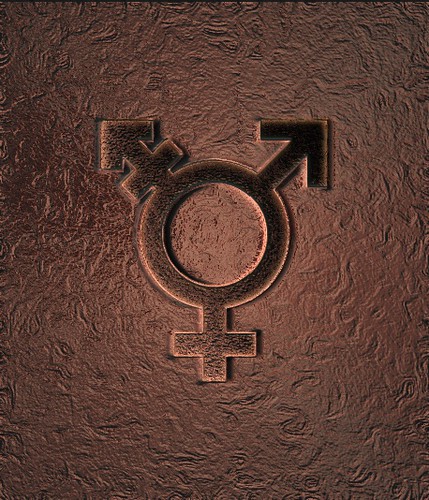
I can't imagine the emotional pain B went through before finding the courage to become transgendered. I can't imagine the physical, psychological, social and emotional upheaval that must go along with such a change. I know that it has cost a lot of money, caused a lot of hardship, and taken a long time. But I do believe my friend is happier now. I have followed the latest news of his transformation on LiveJournal. I am amazed to read on Facebook about the difficulties he's encountered: D is over forty and has no credit history. B has a credit history, but B is no longer a functional identity. Without a credit history or job history, D has trouble getting loans to pay for housing, vehicles, and medical procedures. It is not an easy life. I am impressed by the courage of my old friend.

It took me a few months to remember to call him "D" instead of "B," and to say "him" instead of "her." But the bottom line is this: names and pronouns are simply functional parts of speech. They are not the important human stuff that comprises my friend. For more than 35 years I've known the spirit of a person. That person and I grew up together, shared experiences together. I respected my friend's spirit when we were five and I respect it now. Just because the external package housing that spirit has changed, it does not mean that the spirit inside has changed. My friend is still my friend.  

Jul 27, 2011

Featured on BlogHer: An Open Letter to the Mattel Corporation


Sometimes kids say things that are so unexpected that parents are literally left staring, open-mouthed. We may do all the right things, consider every angle and point of impact that our decisions could have on our children, and we may think we know exactly how our children will respond. But kids always find a way to surprise us. It seems like children are determined to send their  parents into that wild realm of the unknown, making us doubt ourselves and worry that we are scarring them for life.


Flickr photo by joanna8555 
As a woman, I had my doubts about bringing Barbie in to my home. I read, soul-searched and rationalized the implications of having the iconic doll in my house. Even after all of that thinking, Barbie made her way into my girls' lives. From the musical movies where Barbie is hero to the dolls and accessories that have made her such a popular toy for decades, we bought into it all. I thought a lot about exposing my girls to this warped image of womanhood, but was impressed by how much Mattel has done to make Barbie a confident young role model for girls. And that's why I was so surprised when I gave my daughters new Barbies as gifts and they gave me such a shocking response. It was so shocking that I felt the need to write to the Mattel Corporation about it. 

Featured on BlogHer.com"An Open Letter to the Mattel Corporation," was first featured on Multicultural Familia and was recently picked up by BlogHer. You can read the letter and discuss it with the huge community of women on the website BlogHer.com, on Twitter (@BlogHer and @BlogHerCultures)
 and on the BlogHer Facebook page.


You can also read the original post at MulticulturalFamilia.com, a wonderful e-zine dedicated to sharing information and ideas with modern families.

I encourage any readers wo would like to share their thoughts on Barbie to send their own letters to the Mattel Corporation.  I sent this post to corporate.communications@mattel.com and received a response from ConsumerServiceCenter@fisher-price.com.  The more they hear from concerned parents, the more likely they are to make positive changes to their products.

Have your children ever shocked you with their response to something you gave them? Have they ever shed light on a slice of humanity that you'd never before considered? Out of the mouths of babes can come some very insightful things...

Jul 23, 2011

A Little Game of Blog Tag--Siete/Seven


 Flickr photo by Leo Reynolds

I have been tagged! My amiga, Ezzy Guerrero-Languzzi included me in a fun game of sharing.  I recently started following a lot of new blogs, and this game has been a great way to read posts that I missed. I am excited to share some of my older posts AND to tag some of the blogs I've just started following so that I can become more well-acquainted with them! Thank you, Ezzy, for tagging me <3 and I hope that the bloggers I tag will enjoy sharing in this Game of Seven.

The object of the game is to find posts in your blog archive that you think satisfy the seven categories listed below:

Most Beautiful Post
A tribute to my husband, who is a wonderful father.

Most Popular Post
I wrote this post so that I could share it with other alternative educators at a conference where I was presenting. I thought it would only be viewed by a small number of educators in Iowa. Since then it has been viewed by educators all over the world and has even been translated into other languages! It has been an honor to see this post used as a resource worldwide.

Most Controversial Post
This post led to some very interesting conversations with Ezzy and others about the ability to empathize. It started with one thought: should President Obama be more empathetic towards gay people because he is of mixed heritage? 

Most Helpful Post
My fellow Iowans find this post very helpful in dispelling some common stereotypes about our state! There is much more to Iowa than corn :-)

A Post Whose Success Surprised Me
A post that shares some of my experiences being the only white person in a room or a family.

A Post that Didn't get the Attention I Felt it Deserved
This post discusses one of the unintended consequences of No Child Left Behind--white flight.

Post I am Most Proud Of
It was a proud moment, indeed, when Heidi Durrow herself DM'd me on Twitter to thank me for writing this post. I was also proud of myself for sharing some strong emotions about how it feels to be the white mother of mixed children.

Tag! These blogs are now invited to participate in the game! Please come back and link your posts to this one if you choose to participate.


Jul 21, 2011

Failure and Success


“Success is dependent on effort.” Sophocles
My whole life I've believed that hard work will lead to success. Not the kind of success that means I'll be raking in the dough, living a life of luxury; but the kind of success that makes me comfortable to live in my own skin, feeling good about myself and the work that I do. No regrets. Inner peace. Satisfaction in a job well done.  

I want my children to achieve success--not necessarily the kind that is measured in dollars and cents or popularity, but the kind that comes from knowing they have put forth their best effort and achieved a goal. Self-satisfaction, happiness, and continual growth are what I wish for them. To help my children become lifelong learners who know what it means to try their best, I send them to school. Most Americans send children to school so that they can learn and succeed. But how do we measure learning and success in schools?

Some rights reserved by Wayan Vota
Schools are places where teachers and students put in tremendous amounts of effort each and every day. Kids try their hardest to learn and achieve. Amazing things happen in classrooms where teachers are passionate, and they work closely with their students. A student can start the school year only able to read 10 words and end the year able to read hundreds. She can start the year not knowing how to complete a long-division problem and end it knowing how to solve any long-division problem she sees. Miracles of learning happen every day in classrooms all over the world! Yet in our current education system, those miracles don't always count as successes.

According to current U.S. educational policy,  a child who learns long-division after months of struggling is not necessarily a successful student. The teacher who patiently helped that student learn, trying multiple teaching strategies, never giving up until she found the right one, is not necessarily a successful teacher. A school that is filled with students and teachers who grow together, performing miracles of learning each day, is not necessarily a successful school. Why? Because our government doesn't count any educational success that can't be measured by a standardized test.

The Elementary and Secondary Education Act (currently known as No Child Left Behind) requires schools to test their students each year and report their test scores to the federal government. Every student in every school is supposed to meet government mandated proficiency levels. Any school receiving Title I funds and not meeting those proficiency levels is required to notify parents, and give them the opportunity to transfer their children to another school that is meeting proficiency requirements.

  Some rights reserved by Matthew McVickar
According to the government guidelines, by 2014 all students are supposed to be at 100% proficiency. That means everyone will be perfect. Everyone will be successful because all kids in the U.S. will be getting perfect scores on their standardized tests...and if they aren't? Those schools that do not achieve 100% proficiency will be sanctioned. They might get shut down. Those teachers might get fired. And those kids? They will be failures who attended a failing school. They will get a new staff or get bussed to a new school in hopes that they will eventually pass the test. Forget about the miracles of learning, the tremendous effort, or the amazing growth they've shown. If it can't be measured on a test, it doesn't count as success.

Across the country this month, schools that receive Title I funds and are not meeting proficiency on standardized tests will notify parents that they are failing to meet the government requirements. Parents receiving those letters will have the option to transfer their children to another school. If you are a parent who receives such a letter, I encourage you to talk to parents in your neighborhood, call the principal at your school, and find out what goes on in classrooms. You are bound to find examples of success that can't be measured once or twice a year on a standardized test. Look for proof that students are growing and performing daily miracles of learning.  Ask yourself--how do I measure success? Is your definition of success based on standardized test scores? Is your child's success dependent upon how they do at filling in bubbles? Was your success measured in that way? 

If there is more to your definition of success than test scores, consider staying in your neighborhood school and celebrating the incredible effort put in by hardworking students and teachers every day. Celebrate the real successes--the kind that come from doing the best you can... rather than the kind that come from filling in the dots on a score sheet.

Vincent Van Gogh said,
 "Happiness...it lies in the joy of achievement, in the thrill of creative effort."
I agree.  I want to measure my children's success by their happiness and growth...not by their test scores. 

How do you measure success?

_________________________
***Note*** Three states (ID, MT, SD) refuse to sanction schools who don't meet the standards set by NCLB. They may lose federal funds, but they will no longer have to measure success by standardized test scores. This article discusses those states and their decision.

Jul 9, 2011

The Girl Who Fell from the Sky by Heidi Durrow


Reading this book is like remembering the past through a dream-like fog. It's hazy, yet crystal clear at the same time. You know that something bad has happened to Danish mother Nella and her children, but you don't know exactly what. You know that Nella's daughter Rachel, is a survivor; but you don't know how or why. You know that Nella's husband is black, that her children are biracial, but you don't know exactly how that fact impacts her family. The story slowly trickles out in a series of flashbacks, rotating perspectives between Rachel, Nella, a young boy who named himself "Brick", and Nella's boss, a black woman named Laronne.  Rachel remembers her mother, remembers her Danish heritage, but is living with her black grandmother. She is made fun of at school for being blue-eyed and too light-skinned (not black enough.) She is also called by some derogatory terms that white society uses for people of color. We watch Rachel grow from child to teenager, struggling to make sense of her history and her identity.

Image via GoodReads
Heidi Durrow really captures the voices of her characters. Rachel's voice as a child is marked by shorter sentences and has a child-like quality that evolves as she gets older. Nella's voice is recognizably one of a non-native English speaker. Grandma's voice is undeniably African-American. By the end of the book, Rachel's voice is a definite mixture of it all--the Danish and the African-American--and as a reader, you want another chapter, another book, so you can watch her as she strengthens that mixed voice.

Books like this aren't easy to read. I was fascinated both by the story of Rachel, who searches for a place to fit in, but also by the story of her mother.  Nella learns some hard lessons about being the white mother of biracial children in America, and her voice really spoke to me. Her character voices concerns that are not easy to talk about due to our society's difficulty with the subject of race. At one point in the book, Nella finds out that her daughter knows what it means to be black:
 "She knows the word. She is black. I know she is not a word. If she is a word then she doesn't have me."
Here's the thing: I can relate to Nella's feelings. I don't know how to talk about those feelings very well, but here it goes:

As an educated white mother of biracial children, I spend a lot of time thinking of ways to help my children love their brown-ness. We talk about African-American culture and history. They've always had books with brown children in them, and played with brown dolls. They attend school in a building where white people are the minority. Most of their friends look like them. My husband and I are honest with them about what society is like and how they might be treated. But in all of that discussion and appreciation of their brown-ness, I sometimes feel like they are losing me. They are my children. I carried them in my womb, nursed them all until they were toddlers, and I hold them close to me each and every day. 

Adults in our world (both brown and white) seem to see them as only one color. Brown people all offer the same advice, "Prepare them for this world where they will only be seen as brown. They need to learn to defend themselves; they need to learn to be strong." They say, "Look at our president--he is biracial, but our society treats him as black! Of course he calls himself black." They remind me of history, "For generations, our society has adhered to the 'one-drop rule' and your kids need to be ready for that."

I hear all of that, but here I am. Their mother. White. I want them to be ready for whatever the world throws at them, but I also want them to know that they come not only from their father--they come from me. They carry my blood and the blood of my ancestors. There is more to them than their brown-ness. There is also German, Lithuanian, English, and Irish a blood in them. I want them to embrace it all--everything that is in their history, their genetics, their heritage. And I do not say this because of any sense of white privilege...I say this because I feel there should be some kind of "Mother Privilege." I believe this: if you have grown a human being in your body, and you have given your heart, mind, soul over to one purpose--making that human being grow up happy and healthy--why should they be asked to deny you as their blood? Why should they allow society to take away the fact that you are their mother...that you are white...that half of them is white?

__________________
I want to thank Heidi Durrow for writing this book, for her work on Mixed Chicks Chat and with the Mixed Roots Festival. Hearing Nella's voice, listening to the podcast, and reading about the Festival shows me that there is a group of people willing to call themselves Mixed, willing to honor all of themselves and all of their heritage. I hope my children can follow their courageous example.

Jul 5, 2011

Iowa: Same Difference


Image via Wikipedia
When I lived in Miami, a visiting New Yorker asked me where I’d come from.  I said, 
“I moved here from Iowa.”


She replied, “Isn’t it supposed to be pronounced... Ohio?” 


Despite public perception, Iowa is not a state filled with uneducated, redneck hicks. Though a toothless farmer in overalls seems to be the media’s go-to guy when they are reporting stories from my home state, the reality is different.


I think it’s time for progressive, educated people everywhere to learn more about the state where I live.

In the blogosphere and on Twitter, it often seems that Iowans’ experiences are not regarded as relevant. In the case of my own life as a tweeter/blogger, the reactions I get from people are often doubt-filled: I must not know much about diversity in public education because I teach in Iowa. I can’t have much experience with multiculturalism because I live in Iowa. I obviously don’t know what it’s like to teach truly challenging students because I teach in Iowa. The urban tweeting/blogging majority seems to perceive that educational issues in the middle of the country are not as relevant or important as the educational issues that happen on either coast.


I don’t buy into that mindset. Here are some of the many reasons why Iowa should be recognized as one of the most progressive states in the nation:
  • Interracial marriage was legalized in 1851 (Loving v. Virginia legalized interracial marriage in the U.S. in 1967)
  • Slavery was abolished in 1844, (The abolition of slavery was included in the State Constitution before Iowa actually achieved statehood. The Constitution, including the abolition law, was finally fully ratified in 1857, 8 years before the 13th Amendment to the U.S. Constitution was passed)
  • 96 years before Brown vs. Board of Education, in 1868, Iowa ruled that separate was not equal and our schools were integrated

Buxton, Iowa integrated school (note the African-American teacher)
Photo via African-American Museum of Iowa website

  • Women were allowed to enroll at our state universities as early as 1871
  • 80 years before Rosa Parks refused to move to the back of the bus Emma Coger, a mixed race woman, was asked to leave a whites only dining room on a steam boat. She fought the decision and in 1873 the Iowa Supreme Court ruled that she could not be denied the right to eat wherever she wanted to eat
  • Iowa was the first state to name Barack Obama as a Democratic nominee for president
  • Iowa was the third state in the nation to legalize same-sex marriage 
Iowa is definitely a very white state. But don’t let our overall statistics fool you: we are home to some very diverse communities. According to the 2010 U.S. Census, our population is rapidly changing. Many communities in our state boast minority populations of 20-30% --and those numbers are growing.  A town not far from where I live has a Latino majority—only 48% of its residents are white.  My children attend an elementary school that is 58% non-white.


As in other parts of the country, Iowa struggles with growing poverty. As in other parts of the country, we are seeing that poverty and minority status seem to be linked. We have gangs, we have drug problems, and our prisons are overcrowded. As in other parts of the country, we believe that education is the best way to cure wait ails our society. Throughout Iowa's history, civil rights and education have been intertwined.  Iowa strives to be independent from the rest of the nation by doing what is right instead of what is popular. Can other states say the same?

Jul 1, 2011

Obama's gay marriage flip-flopping | Fred Karger


I came across an article this morning from The Guardian that got me thinking:

Obama's gay marriage flip-flopping by Fred Karger 
The author says:
"I am puzzled that a man who is the product of a biracial marriage, whose own parents could not have married in 16 states before 1967, seems unable to understand the extreme pain that bigotry causes."
That comment makes me think about something that has bothered me for a long while--President Obama does not identify himself as biracial. He identifies himself as black. Throughout his presidency, multiracial people have shared their feelings about his choice. Some feel offended, let-down and discouraged. Some argue that his decision to self-identify as black is proof that the "one-drop" rule--that originated in the era of slavery--still thrives today (in other words, if society sees him as a black man, why shouldn't he identify as a black man?)

Here are some opinion pieces that got me thinking even more about the issue:
  • An NPR podcast (with transcript available) from 2008 argues that the term "biracial" is too vague for many. "Biracial" could mean Jewish-Korean, Filipino-Mexican, or some other mixture that isn't specific enough for the President.
  • An Op-Ed from the LA Times that discusses the fact that Obama's personal history--being raised by his white mother and grandmother--led to him being labeled "not black enough" in Chicago politics. The author speculates that maybe this accusation pushed the President to focus on his black heritage.
  • A truthdig piece that tries to tie Loving Day history to current same-sex marriage debates. (The author also mentions another story that has stuck with me: my favorite artist, Jill Scott's comments regarding the pain she feels when she sees interracial couples.)
When I put all of these thoughts together, and then I go back to Fred Karger's comment from The Guardian about how he doesn't understand how President Obama, the product of a biracial marriage, could be "unable to understand the extreme pain that bigotry causes," I wonder... What happens to that logic when you factor in that Obama doesn't identify himself as "the product of a biracial marriage?" If he doesn't identify that way, can you really argue that the Loving's legacy should make him  sensitive to the pain of LGBT people?

What about another explanation altogether: what if the extreme pain of bigotry is what caused the President to identify himself as only black?  Maybe carrying that kind of pain around makes it hard to empathize with the pain of others.

I don't know what goes on in the mind of our President. I do know that his choice to identify as only one race impacts both black culture and mixed culture.
Is the impact good? bad? indifferent? What do you think?


**Note** After originally posting this, I found yet another article on the same topic. Check out this article by a mixed race gay man, writing about his experience in London. A judge asked him, point blank, to choose whether he is "black" or "mixed race." What's Race Got to Do with Identity? | Same-Sex Couples News - gay & lesbian couples, marriage equality, gay weddings worldwide

Jun 29, 2011

Sounding Off (A Wordy Wednesday Post on Being Hearing Impaired)

I am hearing impaired. It's part of who I am. It's not a big deal to me now--I've always been that way, even though I didn't always know that I was hearing impaired.

During college I spent several summers and winter breaks in Miami Beach, Florida working at an ice cream store. In the summer of 1990 the U.S. decided to go to war in the Persian Gulf. News stories ran about soldier shortages, and the media started panics about reinstating the draft. Several news programs ran stories about women in the military. I was 20 at the time, and my imagination took over: what if the draft was reinstated and they decided to require women to register? 20 is prime draft age...  I wondered about it aloud in front of my friend, Mary. She said,
"Jen, you don't need to worry about that. You're deaf! You can't hear a thing I'm saying if your back is turned to me. You have to see me and read my lips to know what I'm saying. The military would never take you." 
Mary's words changed my world...Prior to that, I had no idea that I was hearing impaired.

After Mary's comment I made an appointment with an audiologist, who told me that my hearing loss was severe enough that I could benefit from hearing aids. Thankfully, my parents assisted me on my journey to hearing more (hearing aids are very expensive and are not covered by health insurance.) I got my first pair of hearing aids at age 21.

flickr: Some rights reserved by ikesters 
My first hearing aid experience occurred on the bus ride home from my audiology appointment, and it left me wondering what all the hearing hype was about. Screeching bus brakes are a sound I'd never heard before age 21 (and I can honestly say that it is a sound I could live without!) From that day on, I've made a lot of adjustments. Here are some realizations that occurred after recognizing myself as a person who is hearing impaired.
The pluses:
  • I can choose whether or not to hear certain things. Not every sound is something I want to hear well or hear at all (screeching brakes and police sirens, for example.)
  • While I feel that I can do my job better when I wear my hearing aids, it is nice to take them out at home--especially when my kids are loud. It's nice to turn down their volume by taking my aids out!
  • It is kind of cool being able to lip read! I can secretly spy on conversations occurring across the room, or tell my husband what the coach is saying on the sidelines of televised football game--even when there is no sound.
  • What I lack in hearing, I make up for with other senses. I am very attuned to others' body language and facial expressions. People often don't have to speak in order for me to recognize their feelings.
The minuses:
  • Hearing aids are very expensive. Even the smallest repairs cost more than $100. As a result, when something happens to my aids I can't always afford to fix or replace them.
  • Lots of media is focused on the hearing world and doesn't accommodate those who are hearing impaired.
    • YouTube videos can be captioned easily, but very few people who upload videos take the time to caption them. 
    • There are some amazing podcasts out there, but I often can't hear everything they're saying. Very few podcasts offer transcriptions (1. thank you NPR! and 2. See this helpful site  for tips on how to transcribe your podcasts by using a script or using Dragon Naturally Speaking software.)
    • Netflix recently began captioning some of their streaming content (applause!) but they still have a long way to go. It would be amazing if all videos included captioning!
    • Close-captioning on live broadcasts is often not very accurate. There are lots of misspelled words, typos, mistakes and a great deal of lag--the words come long minutes after the picture.
    • Movies, live performances, speeches, and sermons rarely offer accommodations. When they do, they are bulky headsets that are so uncomfortable they detract from the enjoyment of the event. 
Hearing impairment is a mostly invisible disability, so people don't know you have it unless you tell them.  If someone informs you that they are hearing impaired, here are some tips on how you can communicate with them more effectively:
photo credits: CSAIL
  • Don't assume you need to talk louder unless you are asked to do so.
  • Don't over enunciate or exaggerate your lip movements. Lip readers can read the movements of normal speech, but it is impossible to read someone's lips when they are over-articulating. 
  • Try not to speak to us when our backs our turned. Face-to-face contact is best for verbal communication.
  • Do communicate in writing when possible. Phone calls and face to face meetings are sometimes difficult to follow.
  • Be patient. Those of us who are hearing impaired sometimes miss things. If we know we've missed something we will ask you to repeat it ("what?" "huh?" "Could you please repeat that?") But sometimes we don't even know we missed something! If it looks like someone doesn't hear what you just said, try repeating it.
  • When in doubt, ASK! I think just about anyone with any type of disability would welcome your questions over your assumptions. Don't be afraid to ask! It is more offensive to have someone stare at my hearing aids, holler in my face, or exaggerate their lip movements than it is to have them ask directly about my hearing impairment.


Jun 24, 2011

From PragmaticMom.com--Top 50: Multicultural Children’s Books Every Kid Should Know + My Summer Reading

Thanks to Pragmatic Mom for putting together a really excellent list of multicultural books for all ages!   I am sharing it everywhere I can share! Some of my kids' all time favorites are here, as well as some that I am excited to check out from our library soon. You can check it out here:


The girls are especially excited about finishing the summer reading program and have been reading every day.

All rights reserved: jenmardunc


I also signed up for the adult summer reading program. Here is a review of the second book I have completed--4 more to go!

Jen's bookshelf: read


Color Blind: A Memoir


4 of 5 stars


At first I was just fascinated by the cultural aspects of this book. I did not know that it was common practice for Nigerians to have their children fostered in Europe. I was enthralled by Precious Williams' description of her childhood as ...


goodreads.com

Jun 22, 2011

Wordless Wednesday: When Camp gets Canceled-Time to Cook up some FUN!

 
Making Pizza Dough into Balls (copyright jenmardunc)

Chips Ahoy and Home Made Frozen Yogurt Pie (copyright jenmardunc)


Time to eat! (copyright jenmardunc)


Published with Blogger-droid v1.7.2

Jun 14, 2011

First Encounters: What If?


Flickr: digitalbob8
Over the weekend while running some errands I was listening to NPR and heard a couple of stories that started me thinking/laughing/wondering (the podcast is at the bottom of this post.)

The episode focused on FIRST ENCOUNTERS of every sort--first kiss, first time meeting a foreigner, first time hearing. As human beings we are constantly bombarded by information. What happens in our brains when we see something or someone for the first time?

The simple answer: we categorize. We instantly compare what we are seeing for the first time to the stored information in our brains, trying to make sense of it. This instantaneous process sometimes leads us to jump to conclusions about what we are seeing. Sometimes we label things or people incorrectly. Much of the time there is no malicious intent--we are simply trying to make sense of the world around us. There is a problem, however, if we don't stop to check ourselves--to see if our brain's instantaneous classification system did a good job. There is a problem if we allow our brains to "judge a book by its cover."

Think about all the things that describe who you are. List them.

How many of those qualities are things that you can physically see in less than a second?

Think about the things that people see when they look at you.

How many of those things accurately describe who you are inside?

(If looking at yourself is too hard, choose someone you love--your child, for example, and list the qualities that make them who they are.)

The point is, that in the extremely short time it takes our brains to process information, we are making judgments about what we see. It is natural. It is necessary in order for us to sort out the endless stream of information we are exposed to. But our brains are not always seeing the full picture.

Wouldn't it be interesting if our brains could see deeper than the surface? Maybe there wouldn't be so much hurtful judgment of each other for skin color, body shape, hair type, or other physical differences. What if we could see the essence of each other? What if we didn't just settle on our brain's categorization and went past that first encounter?


Jun 8, 2011

Summer Reading


Yesterday was the last day of working in my classroom for the school year-- it is now officially summer! This is the first summer in three years that I am not taking any classes at the University and I am looking forward to doing something that I haven't had much time to do recently: read for pleasure!


I read a lot, but most of my reading is for teaching or learning. I miss being able to get caught up in the plot and emotion of a book. That is why I signed up for my local library's Adult Summer Reading Program at the same time I signed my children up for their Summer Reading Program. The best way to teach children to be readers is to model being a reader!

In the past I've found some real gems just by strolling through the stacks or looking at the patron recommendations' list at my library. My new familia at Multicultural Familia is inspiring me to revisit some of my favorites, though.  Here are a few multicultural novels that really touched me:

Bless Me, Ultima by Rudolfo Anaya

Image via Wikipedia
This book really moved me. It caused me to think about my own spirituality, how it feels to be pulled between two cultures, and what it is like to believe in magic. Anaya captures the voice of a child beautifully in this story of Antonio, a boy growing up in Guadalupe in the 1940's and 50's. It was required reading for a Chicano Literature class I took and I am thankful that my professor introduced it to me.


The Hindi-Bindi Club by Monica Pradhan
Image via goodreads

This is one of the gems I discovered last summer through the list of recommendations written by my fellow library patrons. It is a novel about mothers and daughters, about cultural identity. The story describes the history of women who move between India and America, how they both cherish and sometimes fight their heritage. One wonderful part of this book is Pradhan's description of how food is used to celebrate and preserve cultural heritage. There are even recipes for the dishes described in the book! I enjoyed reading this immensely, and then enjoyed sampling Indian cuisine and exploring Indian film all summer. Before reading this novel, I really knew very little about Indian culture. It literally opened my eyes to a whole new world that I now really enjoy.


Image via Amazon.com
Deep River by Shusako Endo

Four Japanese tourists visit India. Each has their own spiritual journey as they travel the country during a time of great political turmoil. The book is very poetically written and very emotional. Reading it feels like floating, flowing, and being carried along the deep river of the title. I learned about both Japanese culture and Indian culture by reading this wonderful book. Quite simply...it is a beautiful novel.
Do you have any book suggestions? Please share! I would love to find some new books to read this summer!

Jun 3, 2011

Is that Her Natural Color?


When people see my middle child, their first reaction is almost always the same. They wonder about her hair. Years ago, I might have been offended. We lived next door to another mixed race family who's child was born with bleach-blonde hair and the mom always got the same looks and questions. People wondered aloud if we colored our babies' hair. She was offended. For a while, I was too. It makes you wonder what kind of mom they think you are--one that would but chemicals on a newborn's head to change her hair color! But now it's no longer a shock when they ask what they always ask:

Is that her natural hair color?

 
2011 All Rights Reserved, Bobby Duncan
The genetics are pretty amazing. In order for her to have red hair, she must have inherited the gene from both sides of the family. My sister is red-headed, so we know where it comes from on my side; but my husband is black and the red-headed tendency is not so obvious unless you look at one other feature: freckles. Red hair and freckles go together.

2011 All Rights Reserved, Bobby Duncan
My husband, beautiful mother-in-law and one brother-in-law all have freckles. Beautiful, aren't they?

I found an article that argues the number of redheads will decrease as the races intermingle. But my daughter is an example of how our intermingling races are still very capable of producing vibrant, beautiful redheads.

Jun 1, 2011

Wordless Wednesday: Naturally Red


2011 All rights reserved Jen Marshall Duncan

2011 All rights reserved Jen Marshall Duncan


2011 All rights reserved Jen Marshall Duncan

ShareThis

Related Posts Plugin for WordPress, Blogger...